Woman is revolutionising aged care experiences with innovation

NEW YORK: A registered nurse in her 30s has started a revolution in the aged care market with her innovations.
It’s the middle of the night in the maternity ward in a hospital in Manila, Philippines. A baby is cut, Caesarian-style, from a uterus. Through the glass, a girl is watching. Her name is Joannah. She is six years old.
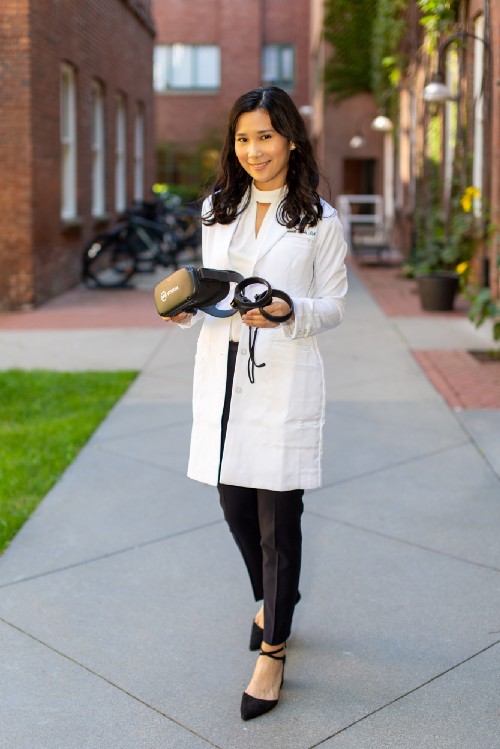
The little girl behind the glass is in her thirties now. I’m speaking to her through another kind of glass — the one we’re all speaking through now thanks to the global pandemic. She is a registered nurse, she lives on the 18th floor of a towering condo complex in the middle of downtown Toronto, and she is the co-founder of RealityWell, a virtual reality platform for aged care residents.
Aged care has made headlines lately, largely as a result of a virus that took seniors as its primary victims. Over 150,000 Canadians now live in long-term care, and as our senior population grows, this number is forecast to grow.
Long-term care as a concept is a relatively new one: until about the Second World War, most seniors died at home, or after a short stay in the hospital. Almshouses were built by charities, but these mainly housed the poor or those left without families. Caring for your ageing parents was easier (and necessary) when your siblings were many, your government took a back seat, and your parents rarely lived past 50.
But things are different now. Families are shrinking, generational gaps are widening, seniors are sticking around (the average life expectancy in Canada is 81.7 years, compared to 57.1 years in 1921) and pension plans have entered the picture.
At the same time, 69% of households in Canada rely on two salaries, meaning there is little time left over to care for ageing relatives. And, in an increasingly globalised world, we are living further and further away from our hometowns.
We are older, busier, and more dispersed than we have ever been.
And that’s why we build long-term care facilities: to transform the messy burden of parental care into checklists and factories fitted with safety rails, non-slip floors, plastic mattress protectors and red emergency buttons on every surface.
But our physical needs are only one part of the picture. 44% of seniors in long-term care have been diagnosed with or experienced symptoms of depression. This astronomical figure is frequently attributed to the pain of watching friends and loved ones passing away, the frustration of a shrinking independence, and the burden of an ever-growing list of pills, pains and health problems. But compare this to the 2% of the general senior population who experience depression, and it seems like where a person lives in the final years of their life makes a significant impact on their mental health. Research indicates that seniors who are supported to stay in their own homes lead happier and more fulfilling lives than those in full-time care.
“If they ever put me in there,” my great-grandma used to say, “slip me the arsenic.”
The real problem is that you do not enter a long-term care facility expecting to one day come out of it. Most residents will hardly even leave the building once they’ve gone in. There are no more outings to the store, no more road trips, no more movies and coffee dates, no more strolls through the park. They will no longer tinker in the kitchen, potter in the garden, fold the laundry or take out the trash. Visits from family members are brief, infrequent, and, in a virus-riddled world, either non-existent, or performed through a pane of glass.
And this is why Joannah Apelo built RealityWell, a Virtual Reality platform for seniors. Virtual Reality usually makes headlines for its applications in gaming and entertainment, but the people who really see potential in this technology are putting it to real and useful work. In architecture, VR is transforming pre-construction visualisation. In medicine, it is training residents in surgical procedures. And now, Joannah and her team are building VR experiences to improve the mental and physical health of long-term care residents.
The VR experiences are designed specifically to exercise the brains and bodies of dementia patients. You can jump in a row boat, cast a fishing line in the lagoon, and try Tai Chi on the beach. There is ambient audio, rich textures, bright, well-lit daytime scenes popping with colour and life. It is a far cry from life in the home.
“It’s like Netflix in Virtual Reality,” Joannah explains. Seniors can explore different real-world environments, travelling to exotic landmarks and faraway cities, attending events and ticking off bucket list experiences, without leaving the safety of their care facilities.
They can also take part in exercise games developed in partnership with the team at the University of Waterloo’s Research Institute for Ageing. These games increase upper body strength and cognitive mobility, improving hand and brain function.
Designing VR experiences for seniors (specifically for first-stage dementia patients) is a challenge of its own. “It has to be simple to grasp, but it also has to exercise their brain and muscles,” Joannah explains. It needs to be low on text and high on colour, brightly lit and filmed with a steady hand. The footage must be shot at seated eye level, because most users will be seated. Even the headset has to accommodate for the fact that most seniors wear glasses.
It’s a work in progress, but it’s one she loves.
It came about during a conversation with friends, as these things often do. It was 2016, and Joannah was looking for her next challenge. Both Joannah and her friends had seen VR making headlines, and each of them saw the potential the technology could have — particularly when it came to training and healthcare.
The back-of-the-napkin talk became a work in progress, which is how the three of them graduated from friends to co-founders, wrangling a team of nine, approaching clients and building VR software from scratch.
This new world is a far cry from the world of the little Filipina girl who spent her nights sleeping in hospital waiting rooms and watching through the glass as her mom, an on-call paediatrician, brought new life into the world. It was largely because of her mom that Joannah ended up training as a nurse.
After graduating, she worked at multiple healthcare institutions before moving primarily to the Parañaque Doctors’ Hospital in Manila. She specialised in various areas, but in her second year, her grandfather was admitted to the very same hospital. A few months later, her grandmother was admitted, and Joannah went through it all again, until her grandmother passed away on the hospital bed.
“I was seeing them every day towards the end of their life. Before work I would come to check on them and see what they needed. After work I would come back and stay there. I would even sleep there sometimes.”
It’s hard, at what feels like the beginning of your own life, to see another’s fade away.
“It triggered me so much because I saw them really deteriorate. I saw their last breath. It really pushed me — like, okay, this is my work as a nurse. You’re really doing it for a lot of people but, when it’s your family, it’s different.”
In August of 2011 she landed in Toronto. It was cold, and dark, and she waited an agonising two hours at immigration, a thick envelope of paperwork clutched to her chest.
In Canada, she had to retrain as a nurse, starting as a Personal Support Worker and then a Registered Practical Nurse and then moving through the Internationally Educated Nurses at York University until she was a Registered Nurse under Canadian standards.
Becoming an entrepreneur was never part of the plan. She had no training in business — she spent her early days in the business talking to CEOs, checking into conferences and loading up on podcasts. But it was nursing that really prepared her for the demands of entrepreneurship. “I know how to prioritise; I know how to organise. I can learn new skills and new technology. I can manage a team. I can handle clients. They might be a little different in the hospital, but they’re still clients.” And the clients she deals with today come from the same world she trained in. “I can’t really say I left nursing, because I still meet healthcare clients. I just don’t work for them anymore — I present solutions to them.”
Today, the team is channeling all their energy into scaling up. VR Vision, RealityWell’s parent company, is still the primary focus, but Joannah is determined to build RealityWell into a self-sustaining entity. Sitting at her kitchen table with her headphones on, sunlight streaming across her one-bedroom apartment, she is hard at work, checking in with clients, wrangling enquiries and deploying projects.
Now that COVID cases are down and restrictions are easing, care facilities are showing increasing interest in RealityWell’s technology. Joannah is setting up client presentations, sending out headsets, and organising trial runs with residents.
It’s worth it when you see the reactions. Some won’t try it; others insist their friends go first. And still others won’t take it off. “I see rabbits,” said one man when the headset went on. “I remember the last time I saw a rabbit. It was in one of my favourite parks, with my wife…” And so it goes.
And there is Joannah, watching, listening. Only this time, there’s no glass.