What ‘care’ now means in design, planning and architecture

NEW YORK: Planners and designers are linking labor, social services and maintenance to building projects by prioritizing the concept of “care.”
A municipal Department of Care could make sure the trash was picked up and the tree pits were weeded. A Department of Care could pay teens to tend to public spaces and teach them stewardship skills. A Department of Care could check on seniors in a heat wave and basement apartment dwellers in a flood. A Department of Care would start by asking, as urban designer Justin Garrett Moore suggests: What do you need? What do you hope will change? How can we best accomplish this?
Of course, the Department of Care doesn’t exist — yet — but the concept of care as a driver for city planning is already gaining traction. Designers, planners, curators and historians are talking about care for an obvious reason: The pandemic exposed just how much labor is involved in child care, health care, street and park maintenance, and technological upkeep. U.S. House Speaker Nancy Pelosi spoke last month at an event hashtagged #CareCan’tWait about the importance of fair pay and training for care workers — and Build Back Better could go even further.
Once people see it, the need for care is hard to unsee. In an architectural context, care links the labor of cleaning with the design of the surfaces to be cleaned, physical infrastructure with social services for its users, landscape with mental health. Care can be demonstrated through org charts and through organizing, through serving food and setting aside land to grow food, through creating public space and training people to take care of it. This is a lot to pile on to a four-letter word — care also has the potential to be just another buzzy term for the same old architecture.
Moore is far from alone these days in talking about care. Design professors at Columbia, Harvard, MIT, Northeastern and elsewhere have incorporated care into their titles and design briefs, often quoting the work of Michel Lussault, Joan Tronto and bell hooks. (A recent lecture series at City College of New York is titled “Architectures of Care,” while Bryony Roberts taught the studio “A City for Child Care” at Columbia, to name just a couple.) One oft-cited text on the relationship between architecture and repair is Shannon Mattern’s 2018 essay “Maintenance and Care,” which emphasizes the former but asks, ultimately, why designers of all kinds of systems are so bent on innovation and newness when “what we really need to study is how the world gets put back together,” and how we care for the people doing that work. These questions have never been more timely.
At the Public Design Commission, the New York City agency that reviews civic architecture and landscapes, “So much of our work was to improve public spaces, buildings and infrastructure in an equitable way,” says Moore, who is now a program officer for Humanities in Place at the Andrew W. Mellon Foundation. “And yet, communities with regimes for added maintenance and care”— block associations, business improvement districts, parks conservancies —“get a higher quality of design.”
The Department of Care — which Moore proposed for New York City in a July report for the Center for an Urban Future — would coordinate services across existing agencies including health, sanitation and transportation, and team with community-based leaders. Such an agency would fill in the gaps, assisting with permitting, coordinating cleaning regimes, liaising with local groups that could provide services to youth or the unhoused — issues that have tripped up New York’s pandemic Open Streets program.
“Care is more comprehensive than maintenance,” Moore explains. “It encompasses social interactions and dynamics, cultural practices. What’s appropriate for West Indian Brooklyn may not be appropriate for the Upper East Side or Dominican Harlem. Things wouldn’t be done the same in every community, and that would be fine and a good thing.”
Care for the public body and care for public space used to be much more connected. Sara Jensen Carr, author of the just-published book Topography of Wellness, traces the division between public health and other disciplines, including medicine and planning, to the professionalization of those fields in the early 20th century.
“As physicians became professionalized, they decided we all should be treated individually,” she says. “People were not as interested in environmental causes.” The result of that split lingers today: “Every time a public health bill gets brought up it gets dismissed as socialism.”
Some of America’s most beloved spaces were designed for health as well as beauty — a form of care through planning. In the run-up to the construction of Central Park, Frederick Law Olmsted “wrote a little bit about nature resorts and the elite leaving the city. He said we need a place where the working class can access nature,” Carr says. In 1870, Olmsted wrote, “Air is disinfected by sunlight and foliage. Foliage also acts mechanically to purify the air by screening it.” Shade, too, was supposed to regulate the microclimate by cooling the soil.
Miasma theory has been debunked today, but as North American summers get hotter — and green space in cities remains difficult for many to access thanks to decades of inequitable development — landscape design remains crucial to public health. Carr, who began her career as a health care architect, says, “I wouldn’t have written this book if I hadn’t moved into landscape architecture and environmental planning. In landscape you start a project and you don’t know how it will look for years, so you have to write very specific maintenance plans.”
Landscape architects could do better at acknowledging the people doing the physical work, but still, other design professions haven’t traditionally had to plot out how use and users would change their projects one, five, ten years in the future. Maybe they should.
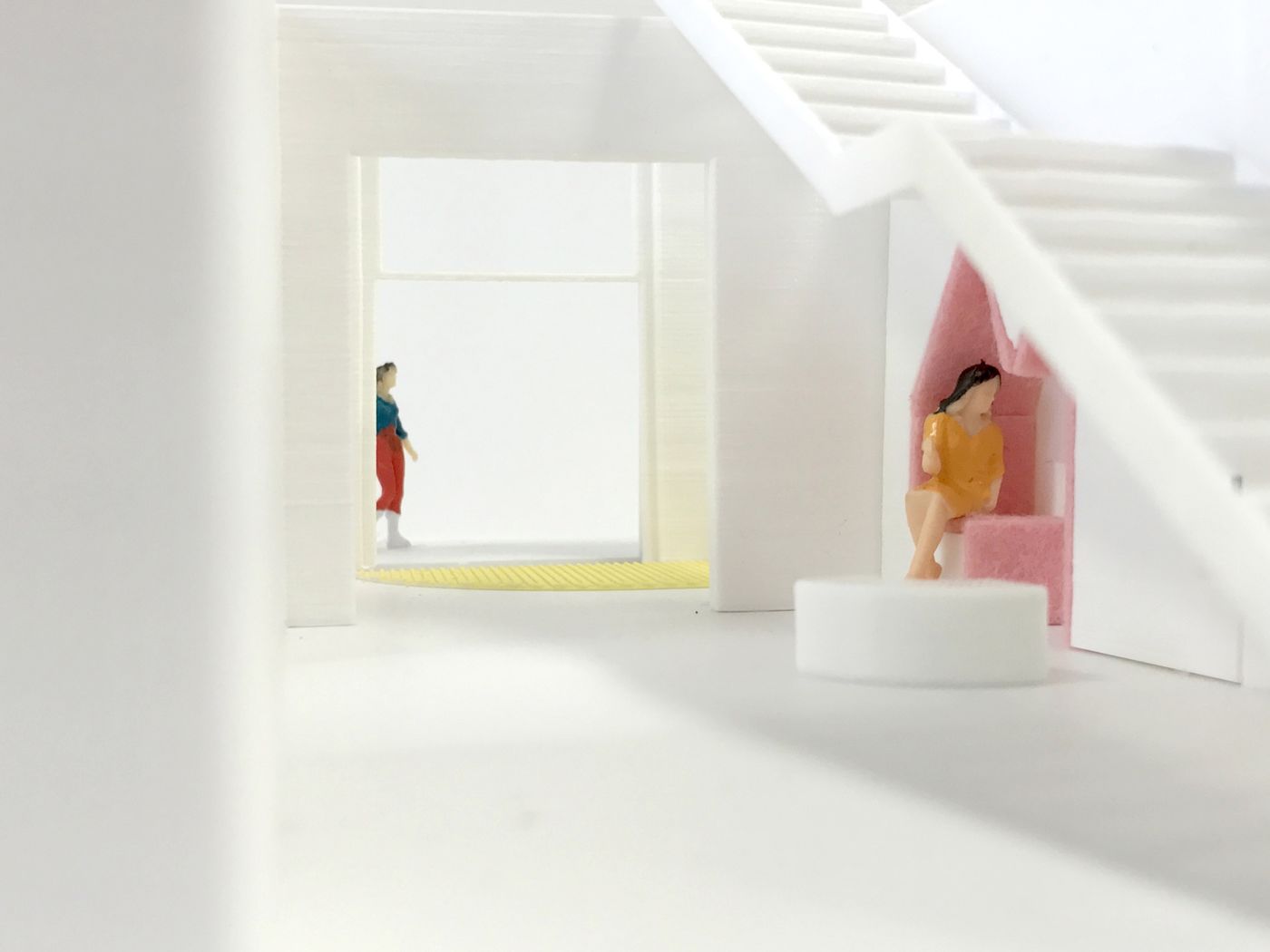
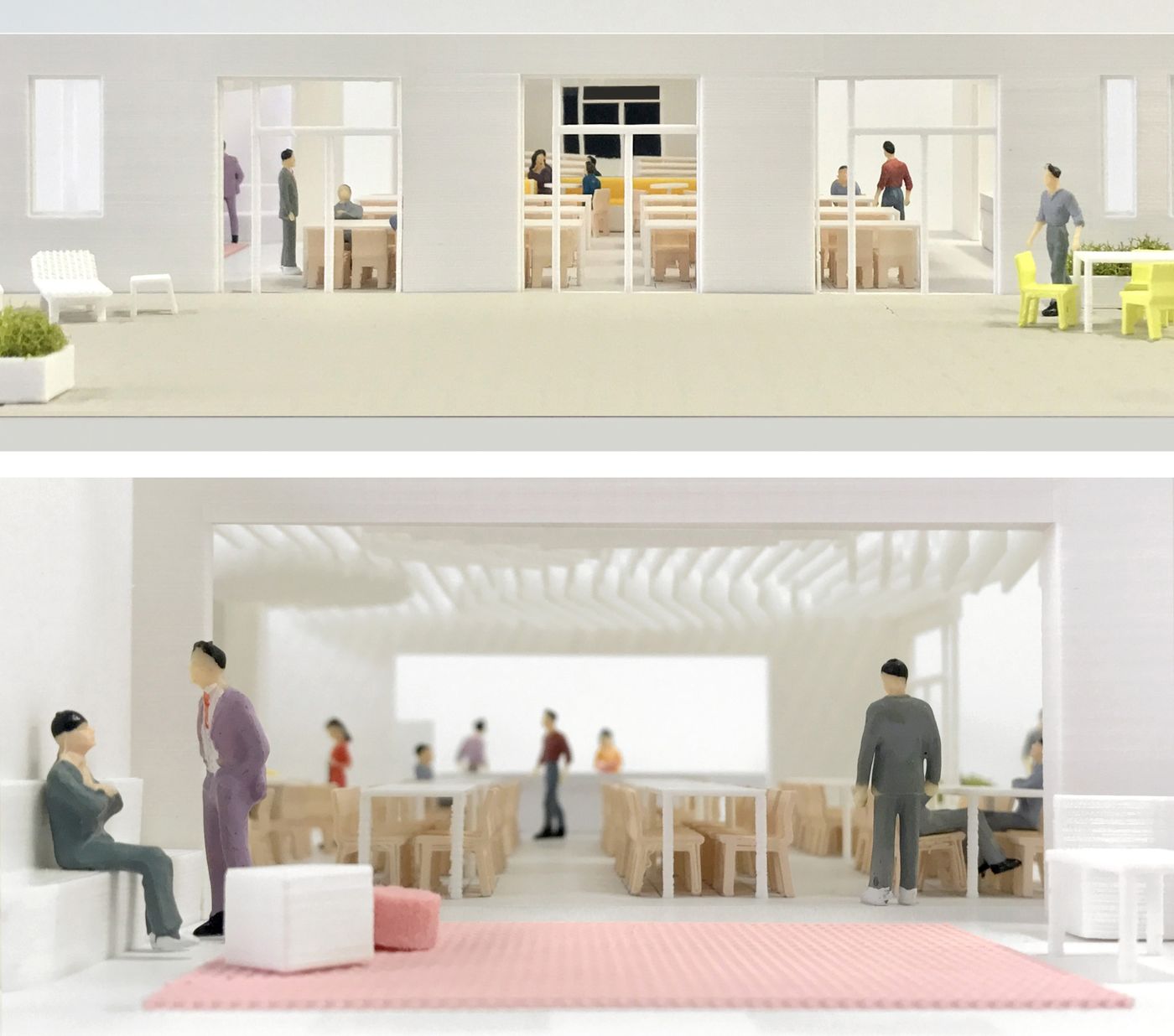
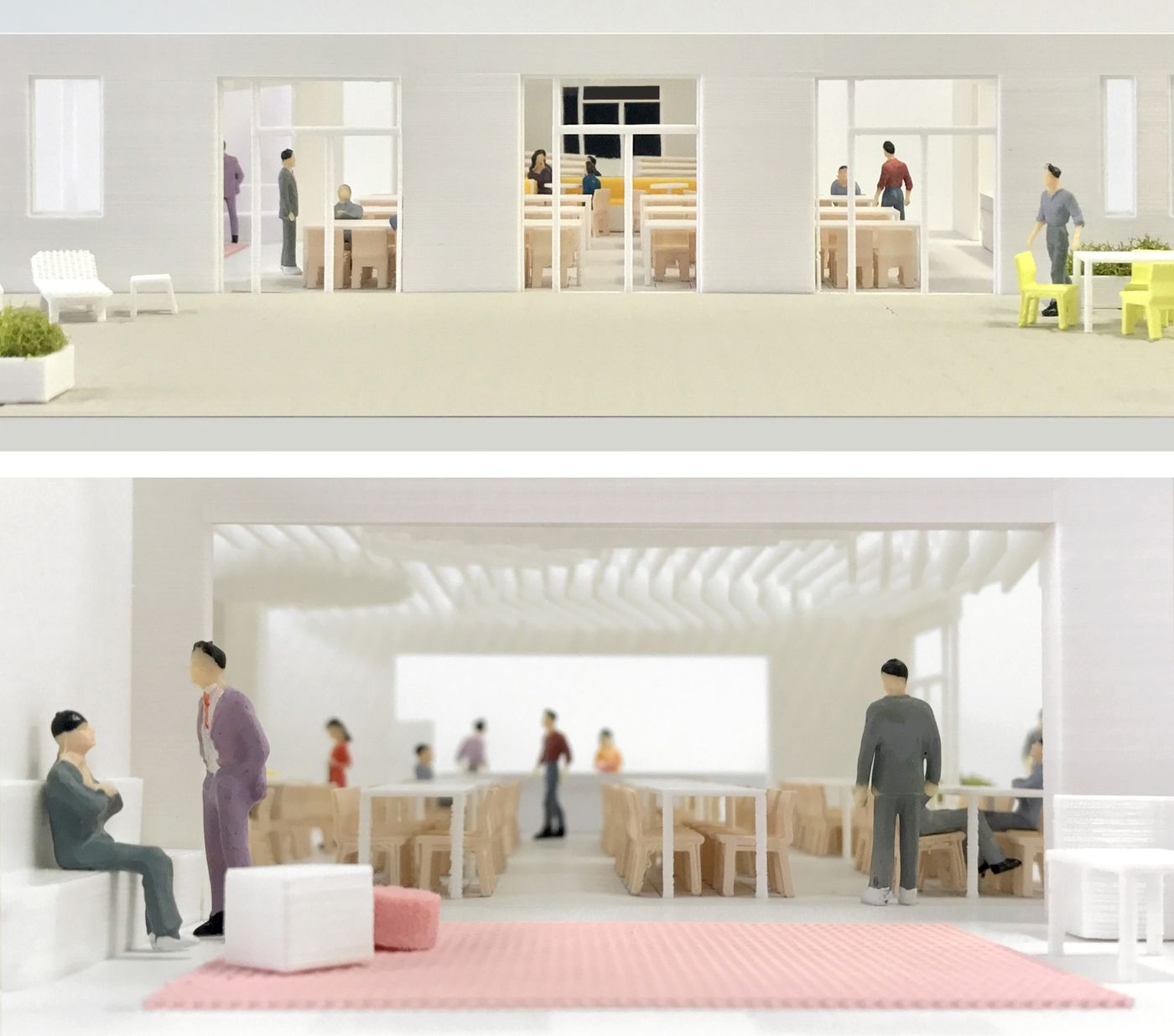
Designing multi-generational housing also comes with long-range planning built into the program. Bay State Commons Cohousing, a condominium project designed by French 2D under construction in Malden, Massachusetts, offers a look at how care can be incorporated into multifamily housing today. As with most cohousing projects, design decisions were made by consensus, with the added challenge of fitting 30 apartments on three-quarters of an acre in a neighborhood of single-family houses. Building in child care was a priority, starting with a semi-enclosed courtyard overlooked by exterior walkways.
“If you trace the hallways, there is always an opportunity to glimpse neighbors occupying interior and exterior common spaces, reinforcing the ability to call on community members to switch off looking after kids,” said Jenny French in an email. “Keeping an eye on younger kids from kitchens takes two forms,” with the communal kitchen separated from the playroom via glass doors, and unit kitchen windows with a view of the courtyard.
Other accommodations are planned for aging: The grounds are graded for accessibility, and one of the studio units could be used by a long-term caregiver. “What does care for a pre-teen or teen and their development look like?” asked Anda French, Jenny’s sister and partner at French 2D. “We had teens and pre-teens in mind when designing more tucked away spaces,” they say. “The overall building is designed with increased sound separation to also allow for degrees of acoustical autonomy despite visual and physical access.”
Alternative design practice has also historically incorporated care. This spring, surviving members of the Matrix Feminist Design Cooperative, launched in London in the 1980s, displayed their work at the Barbican, much of it critical of both the methods and resulting designs of the male-dominated profession.
As Oliver Wainwright wrote of a shelter center in eastern England, the Essex Women’s Refuge: “The complex, designed by a male architect, had got basic things wrong, from the shared kitchen, which was far too small, to the location of the children’s play areas, which were completely separate from the main communal areas, with no visual or aural connection for passive supervision.” Matrix, called in for a fix, gave residents the opportunity to show what they needed via big cardboard models. Care, in practice, meant not just designing for easier child care, but designing a better way of getting input, and then acting upon it, showing the women they were being heard.
Care can also be incorporated into how you select, curate and credit a multimedia research project. Designing Motherhood, a book, exhibition and Instagram platform featuring 100 objects, policies and systems that, as the subtitle has it, “make and break our births,” casts a wider net over what constitutes design and who should be credited as a designer than many museum shows. Designing Motherhood’s multiple platforms offer entries on and examples of the menstrual cup (a 19th-century invention), maternity clothes (an early 20th-century innovation), and paid family leave policy (in the U.S., a work in progress). (Disclosure: I contributed a foreword to the book.)
“I started using this term ‘care’ when I saw it as part of larger conversations about labor in my workplace,” says co-creator Michelle Millar Fisher, now curator of contemporary decorative arts at the Museum of Fine Arts, Boston, and previously a curator at the Philadelphia Museum of Art and the Museum of Modern Art — museums whose staffs have voted to unionize.
Without care practices applied within the design profession, as well as to the products it creates, there’s a chance that “care” might become just another buzzword, akin to the greenwashing that brings us glazed, bird-killing buildings with LEED plaques in the lobby, or architects dropping in to “solve” a neighborhood’s problems in a matter of weeks.
Garnette Cadogan, an essayist and lecturer in urbanism at MIT, taught a class titled “Attending to the Body: Care and Kinship in Architecture and Urbanism” in the fall of 2020. But he’s reluctant to do it again.
“Too many architects are using care as the new red pill,” Cadogan wrote in a text message, “but instead of unsettling your old assumptions they just reinforce them. Somehow architects and architecture historians are treating it like the new skeleton key or an add-on that makes everything more humane and personable.”
Designing for long-term care of people and cities has to involve rethinking design practices and processes from within, alongside less hierarchical interactions with users and maintainers. It is no surprise that so many care examples revolve around children and parenting, since feminists have long connected the unpaid and underpaid domestic work of women to spatial practices that separate home and work. The pandemic has only made more urgent questions connecting the social to the physical, like the one urban historian Dolores Hayden recently asked: “What are the ways in which the physical environment could change to support essential caring work, and what are the ways in which we should recognize the workers?”
Creating cities that can cradle us all is complex: “Care” may be too simple, but at least it gestures at connections between culture, economy, space, health and planning that have been siloed too long.