Upscale apartment project now helping finance affordable housing
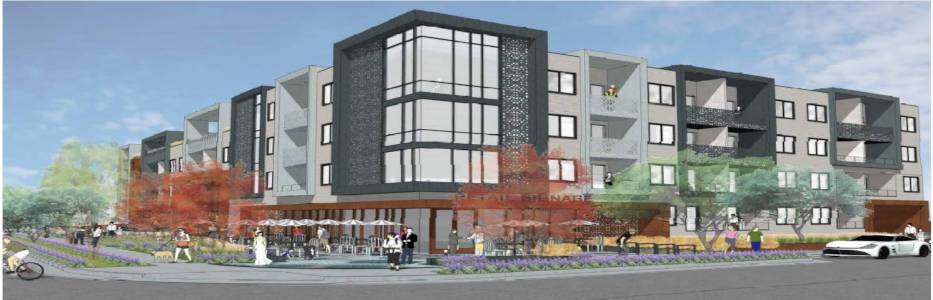
LOS ANGELES: An upscale boomers apartment project is being used to offset the cost of affordable housing creation.
At first blush, the 16 condominium development proposed for 420 Acacia Ave. in Palo Alto seems like a relatively minor addition to the Ventura neighborhood.
The plan by Dividend Homes for what’s currently a 0.8-acre parking lot would include four buildings: three along Acacia and a smaller fourth building set back from the street.
Located a short stroll from the former Fry’s Electronics building, the proposal comes at a time of great change for the Ventura neighborhood, with The Sobrato Organization planning to construct 74 townhomes to replace a portion of the historic cannery building. As part of the same deal, the city is envisioning putting an affordable-housing project with more than 70 apartments elsewhere on the former Fry’s site, as well as a park.
Dividend Homes’ biggest contribution to Ventura, then, may not be these 16 residences but the ones that could go up on the lot next door. Dividend Homes bought its property from the nonprofit developer Charities Housing, helping the nonprofit to finance the largest affordable housing project in Palo Alto’s recent history: a 129-apartment complex at 3001 El Camino Real, which is next to 420 Acacia.
Located on the former site of Mike’s Bikes, the Charities Housing project is steadily progressing through the city’s approval process. While the nonprofit is still working to line up the necessary funding, it is hoping to start construction in 2025, Executive Director Mark Mikl told this publication.
As the names of the two developers imply, the housing projects have conspicuously different objectives. The Dividend development is a profit-focused project with dwellings that will likely cater to well-to-do buyers, while the Charities one is looking to serve residents who make between 30% and 50% of area median income.
The Charities project isn’t the first to target the former Mike’s Bikes site. In 2017, Sobrato submitted an application to construct 50 apartments and 2,000-square-feet of retail there. The developer later withdrew that plan and sold the land to Charities. Charities, in turn, then sold an 0.8-acre portion of the L-shaped parcel to Dividend, leaving the remaining rectangle of land for its own affordable-housing project.
According to records from the Santa Clara County Assessor’s Office, the land has an assessed value of $6.8 million.
“We just sold them the parcel and it’s allowing us to have a more efficient and effective development parcel and it lowers the land cost per unit,” Mikl said.
Using market-rate development to fund affordable housing
The idea of leveraging market-rate housing to help pay for below-market-rate residences isn’t new. A decade ago, the nonprofit Palo Alto Housing Corporation sought to build 60 apartments for low-income seniors and 12 single-family homes on Maybell Avenue, replacing four houses and an orchard. While the City Council approved a zone change to enable the project, residents overturned the decision in a 2013 referendum.
The developer, now known as Alta Housing, maintained at the time that the single-family homes were needed to help pay for the senior housing. Project opponents, for their part, complained about the size and density of the project, its potential to worsen traffic conditions along a school-commute corridor and the inclusion of the single-family homes in the development, which differentiated the project from most other affordable-housing proposals.
The fact that Charities hasn’t encountered this type of opposition reflects a recent shift in Palo Alto’s development climate. Facing a state mandate to add more than 6,000 housing units between 2023 and 2031, the city is revising its zoning laws to permit taller and denser multi-family buildings and finalizing a plan for a 60-acre portion of Ventura that includes the Fry’s site and the Charities and Dividend projects. A key goal of the plan is to bring more affordable housing — along with retail, a park and other amenities — to the area.
Mikl said Charities has been encouraged by recent city actions, including a tax measure that the voters approved last fall. Under an agreement that the council struck with business groups, a third of the proceeds from the new business tax would be devoted to supporting affordable housing. And the city proved receptive to the Charities proposal, Mikl said.
“From the real estate development perspective, they felt this was worth us spending our time and effort to advance a project like that, in this location and this city,” Mikl said.
Some see the Charities project as an important component of a growing affordable-housing ecosystem, which also includes a transitional-housing development that Palo Alto and the nonprofit LifeMoves are preparing to construct at 1237 San Antonio Road, east of U.S. Highway 101.
When Alta Housing was hosting a grand opening ceremony last December for its own affordable housing development on El Camino, Wilton Court, Council member Pat Burt alluded to the city’s pipeline of affordable housing projects, including the Charities project and the Eden Housing development at 525 Charleston Road.
Burt said the recent applications represent the largest spurt in affordable housing that the city has seen in more than 30 years. What’s more, the Charities development would allocate units for residents with “very low” and “extremely low” incomes, potentially taking tenants of the LifeMoves transitional housing project and giving them permanent housing.
“These are a lot of our most vital workers in our community, as well as other people who have … this fundamental need of housing,” Burt said.
The plan for Charities’ housing
By Palo Alto’s notoriously fastidious standards, Charities’ progress through the review process has been relatively breezy. The nonprofit filed its application last year and, after some revisions, received the approval from the city’s Architectural Review Board in May. It then received an approval letter from the city’s Planning and Development Services Department in June.
According to the revised application that Charities submitted last spring, the development would be five-stories tall and include a mix of studio, one-, two-, and three-bedroom apartments. The current plan calls for 24 studios, 40 one-bedroom apartments, 27 two-bedroom apartments and 38 three-bedroom apartments, though Charities has indicated that the mix may vary slightly as the design progresses.
The development will also include amenities such as a large community room with a kitchen; a pantry that Charities will create in partnership with organizations such as the Second Harvest Food Bank; offices for social-service providers and bike storage.
Most of the building would be 60-feet tall, though a stair feature at the end of the building would bring that portion up to 66 feet. Though Palo Alto still has a 50-foot height limit for new developments, that restriction has become largely irrelevant for affordable-housing projects.
Under the state’s “density bonus” law, which provides various zoning exemptions to housing projects with below-market-rate components, the Charities project is eligible for up to 83 feet of height (or 68 feet in the portion next to single-family homes).
The developer is seeking to minimize the project’s impact on the adjacent single-family homes on Olive Avenue, just north of the site, by breaking up the massing along El Camino on the northern portion of the site closest to Olive. Under the revised application, the portion of the building facing Olive features a podium design and a “pedestrian-scale environment” with porches and pedestrian mews.
If all goes well, Mikl said, the project could welcome its first residents in 2027.
“There’s a lot of public and private parties that need to come together to bring the deal together, but there’s a lot of interest in it,” Mikl said.
Bryan Wenter, whose firm is representing Dividend Homes, noted in a letter to the city in March that the proposal qualifies for expedited review under Senate Bill 330, which limits the number of public hearings on a proposed development and which bans cities from changing development rules for a project once an application is submitted.