New report backs retrofit over demolition for public housing tower
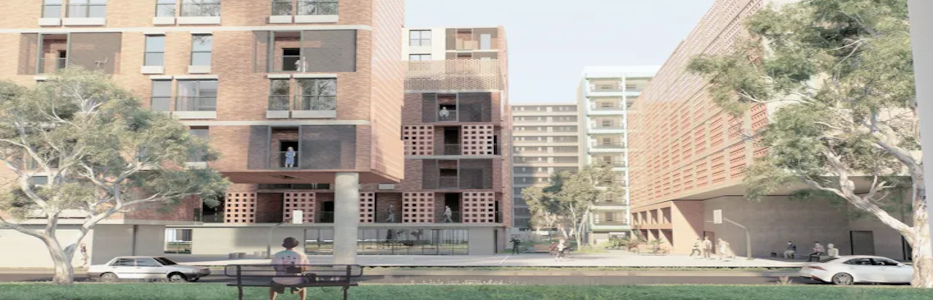
MELBOURNE: Built in the early 1970s for elderly singles and couples, the tower’s demolition and rebuild would carry high environmental costs and risk disrupting established communities, the report has found.
A new RMIT University-led report has found that upgrading the 12-storey Barkly Street public housing tower in Brunswick could deliver better social, economic and environmental outcomes than rebuilding it anew.
Released 30 January, Barkly Street Public Housing Estate – Future Visions, has found demolishing the tower – built in the 1970s for elderly singles and couples – would carry high environmental costs and risk disrupting established communities.
With 97 percent of residents in the Barkly Street tower aged over 55, the report notes that relocating tenants could cause significant hardship, disrupting support networks and limiting residents’ ability to age in place, with potential health impacts.
Instead, Barkly Street Public Housing Estate – Future Visions recommends three retrofit and retrofit-with-infill strategies, noting that upgrading the tower’s 123 units while adding new homes on site could deliver faster improvements for residents, keep established communities together and cut emissions by up to 44.5 percent – with costs comparable to a full rebuild.
The report was prompted by the state government’s September 2023 unveiling of the High-Rise Redevelopment Program, which plans to progressively knock down and rebuild all 44 of Melbourne’s public housing towers by 2051. The government says the buildings, constructed between the 1950s and 1970s, fail to meet contemporary standards for accessibility, safety, ventilation, sustainability, energy efficiency, acoustics and open space, and that the program will triple housing capacity from 10,000 to 30,000 homes.
Report co-author Professor Karien Dekker from RMIT’s School of Property, Construction and Project Management said the findings challenged the assumption that demolition was the only viable option.
“Demolition shouldn’t be the default when it comes to renewing public housing,” she said. “Our findings show refurbishment, with carefully planned new homes added on site, should be properly assessed before decisions are made that force residents to move.”
The study drew on earlier design research undertaken with not-for-profit multidisciplinary design and research practice Office to develop and test alternative redevelopment options that retain and refurbish the existing tower, using environmental modelling, construction costings and spatial analysis.
Report co-author Dr Ben Milbourne from RMIT’s School of Architecture and Urban Design said he was not aware of similarly detailed, publicly available, site-specific assessments for Victoria’s other public housing estates.
“Our aim was to put practical options on the table, with the numbers and the design work alongside what residents told us they need,” he said.
“This kind of assessment should be the starting point for all public housing sites, before any decisions are locked in.”
The report also recommends involving residents early and throughout the planning and design process, managing rehousing risks through staged works, and embedding climate and circular economy principles into renewal decisions.
The same day the report was released, the state government announced the next stage of demolitions, naming seven towers across six estates in Albert Park, Flemington, Kensington, North Melbourne, Prahran and St Kilda.
Residents of these towers will be relocated from the seven towers in July this year.
Minister for Housing and Building Harriet Shing said the government will replace the housing towers “with thousands of modern, energy efficient, and affordable homes, because people deserve homes that meet today’s standards.”
“Our high-rise housing towers have reached the end of their useful lives, and replacing them is not a matter of if, but when – acting now gives more Victorians safer, suitable and more affordable homes for decades to come,” she said.