Modular solution for multi-generational living as housing crisis constrains options
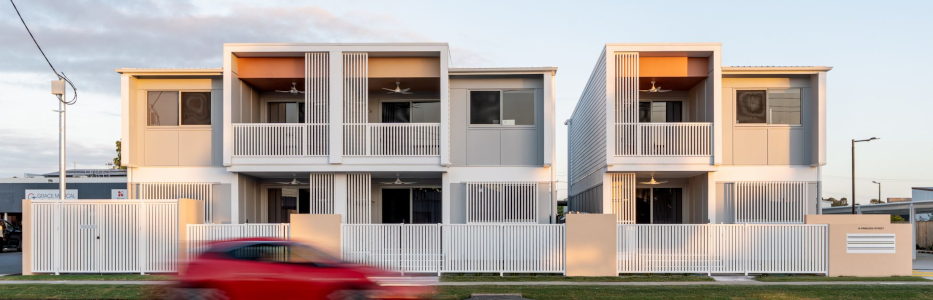
MELBOURNE: If Sheena Carter wants to talk to her daughter or grandchildren, she doesn’t pick up the phone or get on Facebook.
She opens the back door, walks down a short garden path, and knocks on the door of the home next door.
But it hasn’t always been that easy.
Eight years ago, she and her husband Barry Flentjar sold their home in Central Victoria and had a prefabricated modular house assembled on her daughter’s 8-hectare block at the foot of Hanging Rock in Newham, about an hour north-west of Melbourne.
“We had looked at building, but it was just too expensive,” she said.
“Then we bought [a modular home], and it’s been the best thing we’ve ever done. It came in on the back of a truck, delivered like a pizza, and was fantastic for us.”
The move has allowed them to be much closer to family without crowding each other out, while also giving her daughter, Jacqui Carter, some much-needed help. Carter works full-time and has four children with her husband, Cameron Creer, a firefighter on rotating shifts.
Selling their house released financial equity and gave Sheena Carter and her husband the freedom to travel.
As for the grandchildren, the move has given them somewhere to escape, be it for a snack, a chat or a board game.
“We’re very close, Mum and I,” Jacqui Carter said. “But we’re not living in each other’s pockets; she doesn’t come and poke her nose in when she’s not welcome.”
The Carters’ unique living arrangement is part of a push towards more multi-generational living.
The number of multi-generation households jumped from 275,000 to 335,000 in the 2021 census, a 22 per cent increase.
About one in five people in Australia live in multi-generational households, a figure demographer Simon Kuestenmacher expects to keep climbing amid rising housing and living costs.
“We would expect the trend to go up simply because the cost-of-living pressures have increased so starkly, and this is how people react to it,” he said.
While the Carters’ approach was to add another dwelling, some like Michael St Vincent in Newcastle have kept things under one roof.
He’s reconfiguring his family home of 56 years so his adult grandchildren, who are struggling to get into the housing market, can move in if they want.
“It’s our duty as oldies to help out where we can,” Mr St Vincent said.
Mr Kuestenmacher said while multi-generational living was ingrained in some cultures, the broader increase was predominantly a story of necessity.
“Some of this will be out of a choice, out of providing a wonderful intergenerational set-up where the grandparents can help with the grandchildren, and it’s all just a wonderful, helpful environment,” he said.
“But we have to suspect … that the majority of intergenerational households have at least some element of financial necessity built into it.”
There was a quiet that settled over Ellen McNeice’s Toorak home after her husband died six years ago. For years, it stayed that way.
Then, two of her adult sons moved back in while they saved for a deposit. The house, she said, was full again.
Her home needed very little modification to welcome back her new tenants.
“It’s wonderful for them because they’re not wasting money on rent,” Ms McNeice said.
“And it’s good for me because as I’m getting older, it’s nice to have somebody home at night.”
The two generations keep everything separate: individual food, cleaning and living schedules.
They’ll share meals when it suits, but otherwise, they live quite independently.
“We decided when they moved in they would move in not as a mother and children, but as a housemate arrangement,” Ms McNeice said.
Last year, Ms McNeice was diagnosed with motor neurone disease.
She is matter-of-fact about what it means, knowing she’ll have to move out of home one day.
“With a bit of luck I’ll have another year or two in my own home before I have to move into care,” she said.
The housing industry is responding to the changing ways Australians are living.
While the Carters had space on a generous-sized regional block, the number of suburban plots taking on additional buildings is also increasing.
In New South Wales, the number of secondary dwellings approved jumped by 24 per cent in one year, in part to a relaxation of planning laws.
Housing Industry Australia has called for a national approach to planning laws, allowing granny flats of up to 90 square metres to be allowed to bypass lengthy planning queues.
Hugh Hartigan, former head of research at Housing Australia, said modular homes, like the Carters’, are a speedy solution that has yet to completely take-off.
“The main issue is really demand,” he said. “People don’t necessarily trust the product yet.”
Modular or pre-built housing makes up between 3 and 5 per cent of Australia’s construction industry, a fraction of what is achieved in countries such as Japan (about 20 per cent) and Sweden (nearly 50 per cent).
University of NSW construction researcher Riza Yosia Sunindijo said the housing industry faces a structural problem; without a steady pipeline of projects, pre-modular building manufacturers could not achieve the economies of scale needed to bring costs down.
He said a commitment to modular could be a boon for regional areas struggling to fill housing and workforce shortages.
“Modular construction can address both issues by reducing the amount of labour required onsite, while also improving productivity for housing delivery,” Professor Sunindijo said.
Mr Hartigan said modular’s biggest selling point was speed, with homes built in roughly half the time of a traditional build
Modelling by his firm found that with coordinated industry and government action, modular construction could deliver an additional 192,000 homes over the next 20 years.
“To put that in perspective, by about the 20th year, you’d be getting about 20–25,000 additional homes on top of business as usual in the residential construction industry,” he said.
“If you think about the fact we generally get 160–180,000 homes built a year, that would be a huge boost to the overarching residential housing industry.”
Back at Hanging Rock, Sheena Carter is thinking about the future.
She and her husband are in their mid-70s, fit enough to play golf, hike and travel — to Darwin, most recently, for a family birthday.
For now, they help with school runs, pantry raids and family time. Her daughter provides the land, the Sunday dinners, and the grandkids.
“My grandson said last night that Papa is his best friend,” Sheena Carter said with obvious pride. “We’re very, very lucky”.
But one day, the tables will turn. Then it will be her daughter traversing the garden path to check in, rather than the other way around.
“I know there’ll be a time when she’ll need to do more for us, or me, or Barry, whoever’s still living there,” Sheena Carter said.
But for now, they’re enjoying the memories made, and the ones still to come.
“I just wish more people realised that sort of building and opportunity was out there,” she said.
“I cannot believe more people aren’t doing it.”
Who asked the question?
Sheena Carter reached out to share the joy she’s found since purchasing a modular home.
“We bought a modular home that was built in a factory and arrived on a truck. Three months from contract sign to delivery. It’s a fantastic home,” she wrote.
“We were able to ‘build’ it on our daughters’s property and there are 8 of us over 3 generations helping each other and enjoying intergenerational support. We are very lucky!”