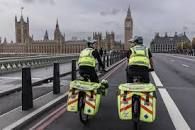
Medics get on their bikes to take load off ambulances
LOS ANGELES: Every day an elite squad of cyclists roams the streets, cycling up to 30 miles and saving lives in between.
The paramedics in the London Ambulance Service’s pioneering Cycle Response Unit (CRU) are each deployed to about seven emergencies a day, including cardiac arrests and traumatic road accidents.
Flying past heavy traffic and nipping through crowds down narrow backstreets, they get to the scene in six minutes on average. By contrast, the average waiting time for an NHS ambulance endured by heart attack and stroke patients reached an hour in England over summer.
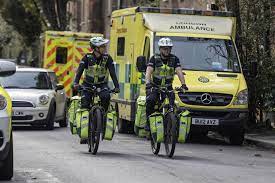
The CRU bikes are loaded with 75kg of equipment, including a defibrillator and electrocardiogram (ECG) machine, so fully qualified paramedics can jump off their bikes and launch into life-saving treatment in the time it takes an ambulance to leave its station.
“We always get there first,” Tom Baverstock, a paramedic who has worked with the unit for three years, said.
“Pedalling fast can be the difference between life and death Baverstock, 35, recalled an incident in August when he received a 999 radio alert for a woman suffering chest pains at her home a mile and a half away. “I cycled full pelt and was there in four minutes. As soon as I got there I did an ECG and diagnosed a heart attack. I upgraded the call to the highest emergency category so an ambulance would come within ten minutes.
“In that ten minutes I cannulated her and gave her morphine, so as soon as the ambulance arrived she could be driven to St George’s Hospital to have surgery. She was on the operating table within an hour of calling 999. Baverstock later received a letter from the patient’s husband thanking him for racing to them on his bike in such hot weather. It read: “Tom saved my soulmate, for which I will be eternally grateful.”
Between them, London’s 40 cycle paramedics attend 17,000 calls a year.
As well as being on hand for life-or-death emergencies, they treat less severely ill patients at the scene. About two thirds of all calls are resolved without the need for a hospital visit.
Each bike paramedic operates solo, covering their own patch, which is much more efficient than the traditional model of every emergency call being met with two highly qualified medical professionals in a huge vehicle.
Baverstock said: “The days of just taking everyone to hospital are over. We can get to the less sick patients, treat their pain, assess them, put them in taxis or call relatives. We can cancel the ambulance that would otherwise have to come.
“We’re taking the pressure off A&E and reducing hospital admissions. In a typical shift you would see seven patients and cancel four or five ambulances.”
On any given day, about 15 members of CRU can be found stationed across congested areas of the capital such as the West End, Soho, the City of London and King’s Cross. They are deployed to wherever a patient needs them – including Underground stations, shopping centres and hotels.
There is a dedicated team at Heathrow, with one cyclist at each of the five terminals, attending emergencies in places such as baggage collection halls where ambulances cannot reach.
The demands of the job are physically intense. Each shift typically involves cycling 20 to 30 miles on custom-made mountain bikes. Joining Baverstock and his colleague Matt Hope for a shift this week, I was (just about) able to keep up during a 15-minute dash from Trafalgar Square to Holborn weaving through tourist hotspots to respond to a 999 call for an elderly man who had a fall but arrived out of breath, with jelly legs, and in no fit state to leap into lifesaving action. And that was after cycling on a bike that wasn’t weighed down with medical equipment.
“You have to stay fit, you have to be a professional cyclist,” Baverstock said.
“You might have to cycle really fast up a hill 11 hours into a 12-hour shift.
You have to be able to pedal just as quickly as you would at the beginning of the day.
The NHS is struggling with a high staff turnover and low morale, but staff in the CRU are not just super-fit but smiley too. The tight-knit team proves its worth during major London events, including the Queen’s funeral, when ten cyclists patrolled the crowds of mourners. Baverstock and Hope were awarded an NHS “excellence report” after treating multiple patients at once near the gates of Buckingham Palace.
The Queen’s funeral was the biggest job in the history of the CRU, which was launched in 2000 as the brainchild of Tom Lynch, a former European and British BMX champion. Lynch grew increasingly frustrated sitting behind the wheel of an ambulance in heavy London traffic, knowing he could reach the scene quicker on his bike. He persuaded NHS bosses to let him start a pilat scheme involving Be paramedic Since then the CRU has gone from strength to strength and is hoping to expand further afield, at a time of record NHS waits when entire fleets of ambulances are queueing outside gridlocked A&E units.
It is good for the planet as well as patients, of course. The team prevents about 51 tonnes of carbon being emitted each year through saved ambulance trips. The CRU has also recently acquired a fleet of eight bikes, allowing paramedics to cycle further and faster.
“There is no reason why cycle response units couldn’t operate in other cities around the UK,: Baverstock said “Bike ambulances just make sense.”
-
- Matt Hope and Tom Baverstock cycle up to 30 miles a day while carrying 75kg of equipment.
-
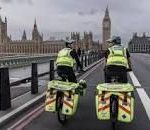
- Matt Hope and Tom Baverstock cycle up to 30 miles a day while carrying 75kg of equipment.