Medical research pioneer to turn focus on to Parkinson’s

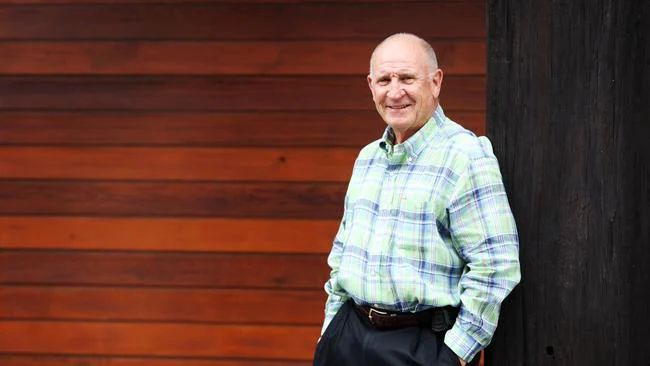
NEW YORK: A world famous medical researcher is now focused on using new laser technology to address the dilemma of Parkinson’s Disease.
When Peter Farrell, the Houston-based founder and chair of $46bn sleep apnoea company ResMed, was contacted by a Sydney-based American friend, Peter Carre, to invest in a new medtech start-up which aims to reduce the symptoms of Parkinson’s disease, it struck a chord.
Farrell did not know much about the laser technology which Carre was proposing to use through his new company Symbyx Biome.
Working in the US for years, Farrell has a long history in the global medtech industry, recently watching closely the unfolding of blood-testing company scandal Theranos in the US.
But Carre’s appeal struck a personal chord with Farrell, as he had seen first-hand how Parkinson’s affected people.
Farrell had watched his grandfather, an entrepreneur with his own electrical company, struggle as he dealt with shaky hands.
“It was hugely inconvenient for him, dealing with electric circuits and having the shakes,” he recalled.
He had watched another of his friends in Houston, a two handicap golfer who would follow his South Korean wife around the professional golf circuit, too worried about his shaking body to get on a commercial plane.
“The symptoms – the shaking – are very serious,” says Farrell.
“This is one of the reasons I became interested in Symbyx.”
Farrell admits he still does not fully understand the laser technology behind Symbyx, which stimulates the production of dopamine and serotonin in the stomach to stimulate the brain of Parkinson’s sufferers, reducing symptoms which also include speech problems and depression.
But he is no ordinary investor.
A self-made billionaire, it was his enthusiasm for a new technology for sleep apnoea, developed by Sydney University professor Colin Sullivan, which saw him buy the business off his then employer Baxter back in 1989.
ResMed now turns over more than $3bn a year with a market capitalisation of some $46bn, making an annual net profit of more than $470m. Listed on the ASX and New York Stock Exchanges, it ranks alongside CSL as one of the most successful medtech companies on the ASX.
Farrell still chairs the company, which is now run by his son Michael from ResMed’s headquarters in San Diego, one of the biotech capitals of America.
When assessing medtech companies, Farrell says, you may not know the details of the technology but you have to assess the credentials of the people who are behind it.
During a visit back to Sydney, Farrell met with his friend Peter Carre, an American lawyer and medtech entrepreneur he had known in San Diego, who moved to Australia after he met his Australian wife in the US.
Over dinner Carre introduced him to his co founder and chief executive – South African born, American educated Wayne Markman.
Like Carre, Markman found himself in Australia having met an Australian – in his case when they were both attending Harvard Business school.
They returned to Australia. Markman worked for investment bank Credit Suisse for several years before stepping back to become a “Doctor of Chiropractic”, while his high-powered wife Sally MacDonald ran ASX-listed Oroton and then the Woolworths owned Big W.
Markman had met Carre when their children attended the same school in Sydney.
Carre realised Markman’s unique background in business and medicine, particularly his passion for treatment which did not involve patients having to take drugs.
“Wayne was a physician who thought the technology had enough promise for him to give up what he was doing and join Peter (Carre) as chief executive,” Farrell says. “I found him to be a very credible guy. We spent a couple of hours over dinner talking about the technology and where they thought they could take it.”
For his part, Markman was keen to learn from Farrell and the story of his founding ResMed.
“I asked him how he started ResMed and what were the issues he faced,” Markman says.
Running a start-up medtech company only two years old, Markman was particularly interested in the regulatory issues which face medtech companies getting approval from agencies around the world, including the rigorous US Food and Drug Administration.
“That’s the benefit of having a guy like him as an investor,” he says.
“In our business, the regulatory approval process is treacherous. It can kill a start-up medtech company.”
Farrell says the initial data from Symbyx’s trials has been “quite promising The patients have reported a significant reduction in the shaking”.
The company has just announced new trials of its laser technology in South Australia and Toronto.
Its products are on sale commercially – it has a website where people can buy its product directly – but the issue for its investors will be whether it can become a commercially viable global business.
Farrell reckons his long experience investing in the medical technology business has made him “hard to fool”.
Asked about the Theranos scandal, which he has been watching closely, he points out that the once high-flying Holmes, who is awaiting sentencing following conviction for wire fraud and other offences, had some very distinguished backers, including Henry Kissinger and former US Treasury secretary George Shultz.
But he says the telltale signal for investors should have been that they themselves had no expertise in medical technology.
Farrell says he is astonished at how Holmes was able to win the confidence of hard-nosed business leaders like the chief executives of US pharmacy chain Walgreens and Safeway, who were both keen to have Theranos’ blood testing kits in their stores.
“What amazes me is how the chief executive of Walgreens and Safeway could be taken in by this woman,” he says. “She must have been a hypnotist.
“I am fascinated about how she got away with so much.”
Farrell had some contact with one of Holmes’ early backers, Stanford University professor Channing Robertson.
For those interested in investing, particularly in medtech and biotech start-ups, he strongly recommends the book Bad Blood: Secrets and Lies in a Silicon Valley Startup, by Wall Street Journal reporter John Carreyrou.
One of ResMed’s directors, Karen Drexler (a chemical engineer from Princeton and an MBA with honours from Stanford) was briefly part of a group of female chief executives advising Holmes.
“They had a couple of meetings,” Farrell says. “She (Holmes) came in dressed like (Apple founder) Steve Jobs.
“She took zero notice of their recommendations.”
Through mutual contacts, Farrell also suggested a medtech expert he knew as a potential director for Theranos.
“She ignored the recommendation,” he says.
One of Farrell’s other investments is a small Nasdaq-listed company, Arcturus Therapeutics, which he chairs, which is working on the regulatory approvals for a Covid vaccine.
(Farrell got Covid last year, despite being vaccinated.)
Farrell is fiercely proud of the success of ResMed, which his son Mick (a Master of Science in chemical engineering from MIT with an MBA from MIT’s Sloan School of Management) has been running since 2013. “At the time Mick took over, we had 5000 employees. We now have 8500 employees in 140 cities.
“We haven’t started yet. We are literally lacing up our shoes before the marathon.”
Meanwhile, he is keeping an eye on Symbyx from afar.
Other investors in Symbyx include former Business Council president Graham Bradley, who chairs Energy Australia, and the ASX Gowing Brothers fund, founded by the family once involved with the clothing company.
The company’s next round of fundraising, expected later this year, will focus on US investors, particularly in San Diego and Silicon Valley, with Farrell’s connections being an important sales tool for other would be investors.
Parkinson’s, like business, knows no global boundaries.