Grandparents dropping everything to give their grandchildren a home
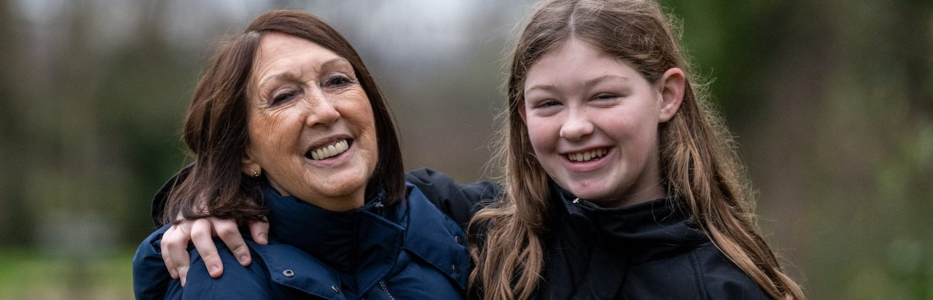
LOS ANGELES: Like many couples approaching retirement, Rod and Julie had plans for far-flung holidays, meals out and spending precious time together after 40-plus years of working, raising three children and helping care for their six grandchildren.
Today, those plans are on hold.
Two and a half years ago, their daughter Katy, then 38, suffered a stroke while giving birth to her daughter Savannah. With Katy too ill to care for her newborn, social services gave Rod and Julie a stark choice: take their granddaughter home or she would enter care.
“It was an easy decision really,” says Rod, 70, an engineer from Chesterfield. “We brought her home from the maternity ward when she was five days old and she’s been with us ever since.
“Now I’m full-time Grandpa changing nappies, feeding and dressing her while Nana goes to work. We don’t go anywhere without her. We wouldn’t have it any other way, but it’s not how either of us imagined life would be.”
Julie, 62, who works part-time as a chemist dispenser, agrees.
“I mourn the life we had planned, but I’d rather miss out than have Savannah somewhere we don’t know,” she says. “She’s our seventh grandchild, but our relationship with her can never be the same as with the others.
“I won’t be the Nana who just gives treats. I’m the one parenting and setting rules. We’re exhausted every day, but I couldn’t have lived with myself if she’d gone into care.”
Daughter Katy is now living independently and sees Savannah regularly but is still not well enough to look after her.
Rod and Julie are among thousands of grandparents across Britain who have become kinship carers, stepping in to raise children when their parents cannot.
According to the charity Kinship, more than 141,000 children in England and Wales are being raised by relatives or close friends. Unlike foster carers, kinship carers often receive little preparation or help, despite saving the state billions of pounds by keeping children out of the care system.
“One unexpected phone call can turn their lives upside down,” says Lucy Peake, chief executive of Kinship.
“Unlike foster carers, kinship carers have no notice and are not entitled to the same financial, practical and emotional support. Many are forced to sacrifice jobs, pensions, savings and even their retirement to keep a child they love out of care.”
The charity estimates kinship carers contribute £4.3bn to the economy through the support they provide.
After taking Savannah in, Rod and Julie initially began the fostering process but later applied for a Special Guardianship Order (SGO), which gives them enhanced parental responsibility until she reaches adulthood. Savannah’s birth father was never on the scene when the couple applied for the SGO.
Julie admits she feared the courts might consider them unsuitable because of their age.
“I was panicking, thinking, ‘What if they say we’re too old?’ When they finally approved it, I just sat there crying.”
But the arrangement has had financial consequences. Julie reduced her working hours significantly, and the couple estimate they lost around 70 per cent of their income. Yet they say it’s rewarding too.
“Savannah has helped me in ways she will never know,” says Julie. “When I lost my father nearly two years ago, I am sure I would have ended up in a very dark place if I hadn’t been looking after her. Although it’s tiring, I cherish every moment we have with her. She’s a little star.”
‘Our savings are virtually gone – we may have to sell the house’
As with Rod and Julie, Neil and Ann also never expected to become parents again in their sixties.
The West Sussex couple had built successful careers, raised two daughters and were enjoying life as grandparents to four grandchildren when their youngest daughter, Emily, was diagnosed with breast cancer at the age of only 36. At first, she thought she had beaten it and was thrilled to walk her son to his first day at school that September.
But then in November, she started to get severe headaches and ended up in A&E with “what we thought was a stroke”, says Neil. “But the doctors told us she had secondary cancer in her brain which was terminal.”
Emily, a single parent, and her son Liam moved in with them immediately.
“Everything became about caring for Emily and making the most of the time she had left,” says Ann, 73.
The local community rallied around, bringing meals, food and flowers. But Emily died two months after her terminal diagnosis, leaving Liam without his mother at the age of five.
“Emily was worried that Liam would forget her, so we promised that we’d keep talking about her, which we do all the time,” says Neil, 72, who still runs a clothing business. “But one day he told us he couldn’t remember what she smelled like. That was heartbreaking.”
The couple were granted an SGO and became Liam’s primary carers. “When we applied for the SGO it was in the middle of the Covid pandemic and the court had to contact the birth father for permission. He sent a letter to say he had ‘moved on’ and so the courts decided that Liam would be best placed to live with us,” says Neil.
“You go into a completely different gear,” Ann says. “One day you’re two older people pottering along, and suddenly you’re responsible for a five-year-old child.
“We used to travel the world as a couple. But then we found we were having to research family resorts and kids’ clubs instead. I remember taking Liam away on holiday not long after his mum died and a friend said she noticed a difference in us when we returned. She said that we went away as grandparents and came back as parents.”
Finance has become a growing concern for the couple.
“We receive child benefit and a small guardianship allowance, but our savings are virtually gone,” Neil says. “We may eventually have to sell the house, which we don’t want to do as we have such a supportive network around us here.”
The couple also have worries that are unique to older carers. Ann has experienced significant health problems in recent years, including a serious accident.
“I remember telling a specialist, ‘You need to keep me alive. I’ve got a grandson who needs me.’”
For Neil, the fear goes even deeper.
“Everybody who has ever loved Liam has left him. His father left. His mother died. One day we’ll be gone too.”
His mother died. One day we’ll be gone too.”
‘We are this grey, invisible army of carers’
Although Neil and Ann had months to think about what would happen to their grandchild, many kinship carers are forced to take this life-changing decision on the spur of the moment.
Wendy, now 73, also from Sussex, was sitting at work with a cup of coffee at 8.30am when social services called her with some shattering news.
“They told me if I didn’t collect my 17-month-old grandson Callum by 10am that morning, he would be taken into care,” she recalls.
“My daughter was ill and could no longer look after him and his father couldn’t care for him either. The social worker made it clear that if I didn’t step in, Callum might be adopted.
“I said yes immediately of course and collected him straight away. But I didn’t even have time to consult my husband, Len, who was out at work.”
The following day, Wendy asked a social worker how she was supposed to continue working as a bookkeeper.
“They told me if I took Callum on, I couldn’t keep working. Nobody asked how I was supposed to survive financially. Luckily, Len – an office manager – could keep working but I know some kinship carers have to give up work completely.”
What began as an emergency arrangement quickly became permanent. And four years later, when her daughter became pregnant again, Len and Wendy knew they would have to take in Callum’s sister Willow as well.
Willow’s father had never been involved with her, but Callum’s father has been around “and we have a really good relationship”, says Wendy. “But at the time, he couldn’t take him on and supported us through the court proceedings.”
“The sacrifices happen immediately when you become a kinship carer,” adds Wendy. “Meals out stop. Holidays stop. Retirement plans stop. You lose a huge amount of freedom. At the same time, there are emotional sacrifices too.
“As grandparents, you’re normally the fun ones. Then suddenly you’re the person setting boundaries and telling children off. There’s a grief attached to losing that grandparent role.”
Sadly, tragedy struck after Willow’s birth when the children’s mother died. Then Len died suddenly four years ago, leaving Wendy – by then nearly 70 – to raise the children alone.
“That was incredibly difficult because he was such a huge part of their lives,” she says. “The children were grieving and all my energy went into helping them cope. Looking back, I don’t think I properly dealt with my own grief because there simply wasn’t time.”
Like Ann, she has also suffered poor health. “I’ve got arthritis and I had cancer last year with no respite, attending the chemo sessions on my own because you just have to carry on and there was no one to help.
“Kinship caring is not recognised for what it is, even though the outcomes are so much better than fostering where children can be passed from pillar to post. We are this grey, invisible army of carers simply getting on with things and we don’t have the energy to shout about it.”
Lucy Peake from Kinship agrees and the charity is lobbying for kinship caring to be recognised more. “Children who cannot live with their parents need love, stability and a sense of belonging,” she says. “Kinship carers provide exactly that, allowing children to remain within their family, community and support networks rather than entering the care system.”
Despite the challenges, Wendy says both children have thrived. Callum, now 20, works part-time as a football referee, while 14-year-old Willow competes internationally as an inline hockey player.
“There were times when I sat outside courtrooms terrified I was going to lose them,” she says. “But then I look at the young people they’ve become and I know I’d make exactly the same decision again.”