Development could be model for extremely affordable senior housing
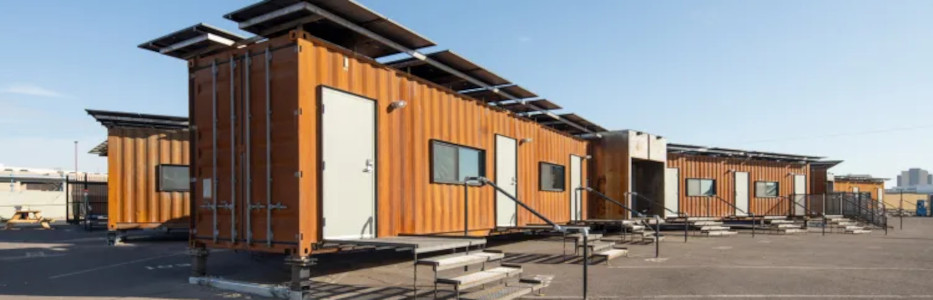
LOS ANGELES: Made of repurposed shipping containers and powered by solar energy, the project combines transitional housing and affordable apartments on the same site.
Heat radiated from the shimmering streets for months on end this year as Phoenix experienced a record 113 consecutive days with above-100-degree temperatures. It was the city’s hottest summer on record, surpassing that of last year, when the county medical examiner recorded an unprecedented 645 heat-related deaths.
This is part of the impetus for an unusual city-sponsored project that officials hope will become an oasis for some of its most vulnerable demographic: homeless and cost-burdened seniors.
“Senior Bridge” is being developed on a 1.7-acre site across the street from a Budget Motel, a few blocks north of Sky Harbor International Airport. It will use repurposed shipping containers to create 40 individual transitional units for unhoused people 55 and older, and around 65 permanent affordable apartments for tenants of the same age with 30% or less than the area median income (AMI).
With 24-hour supervision, the integrated short-term/permanent housing project aims to create a continuum for both sets of residents, with comprehensive on-site support and individualized case workers available to all. Staff members from Mercy House, a California-based homeless service provider, will assist with things like establishing benefits, connecting with healthcare resources, and preparing for housing and employment prospects.
“Everyone has a different story,” says Mercy House program officer Timothy Huynh. “Some have disabilities or [a history of] long-term homelessness, and need deeper interventions with ongoing support. Others are newer to homelessness and may be quick to engage with employment programs or just need a little time getting back on their feet. In a project like this, we’re looking to address the entire system to help people get to a place to land after interim shelter.”
The 160-square-foot transitional units—two per container—will each have kitchenettes with fully accessible bathrooms and accommodate stays of around four to six months. The three-story apartment building will include 380-square-foot units with large screened-in patios.
The structures, equipped with high-efficiency 2-ton mini-split air conditioners, will be powered entirely by rooftop solar panels and lithium batteries, reducing their carbon footprint, sparing tenants electricity bills, and eliminating enormous operational costs.
“We’re excited to partner on this project because of the innovative, efficient design,” says Rachel Milne, director of homeless solutions for the city of Phoenix. “And it will add a lot of units of much-needed affordable housing, and get people off the street and out of the heat.”
There’s an estimated national shortage of 7.2 million homes this year, and over the past four years, home sale prices have exploded by 47%. Most new construction and big builders continue to focus on higher-income consumers, which means affordable housing has fallen by the wayside, feeding into a long-established pattern.
“Both before and after the 2008 financial crisis, the U.S. experienced home price appreciation that outpaced overall economy-wide inflation,” says Kevin DeGood, director of infrastructure policy at the Center for American Progress (CAP). “This rapid appreciation was especially true in large, dynamic metropolitan regions.”
Pandemic supply disruptions pushed sales prices and rents even higher as unemployment and homelessness spiked. Nationwide, the number of people who used emergency shelter for the first time jumped more than 23% from 2019 to 2023.
“Homelessness is a complex social phenomenon that cannot be reduced to any one cause,” says DeGood. “That said, when the cost of shelter rises quickly in real terms, it places a significant financial burden on individuals and families who are in a precarious financial situation.”
This includes the elderly. Some 17 million adults ages 65 and older—roughly one in three—have incomes below 200% of the federal poverty level. (This could worsen, too, given that more than 10,000 Americans turn 65 every day, and the “silver tsunami” is projected to swell from 58 million in 2022 to 82 million by 2050.)
In Phoenix, which has no rent control laws and saw median rental prices increase 46% from 2022 to 2023, many older renters live on very limited fixed incomes. Last year’s point-in-time report put the number of people ages 55 and older experiencing homelessness in Maricopa County at more than 2,000, with more than 600 ages 65 and older.
“We’re seeing grandmothers, people in their late seventies, living in tents, people who’ve never been homeless, and that’s a huge problem,” says Brian Stark, co-owner of Steel +Spark, the small local company developing Senior Bridge. “We have to solve it on the streets but we also have to turn off the faucet that keeps putting people there.”
An architect and general contractor, Stark established himself on the local scene with several unique shipping container projects over much of the past decade. A six-story project with 18 apartments and commercial space on a tiny downtown lot, for example, was described as the nation’s tallest shipping container development when it opened two years ago. His firm has also produced solar-powered accessory dwelling units (ADUs), with refillable water tanks and incinerating toilets, that require no utility hookup whatsoever.
When Stark and his business partner, Kathleen Santin, attended a solar expo in Southern California a few years ago, they saw a variety of building prototypes. That’s also where Stark first saw a “pallet” village, comprised of 120-square-foot fiberglass-and-aluminum units, which have cropped up throughout the country as interim solutions over the past few years.
In fact, “tiny home” interim shelter communities have rapidly emerged in cities nationwide, products of a booming—and perhaps exploitative—industry. Patrick Sisson recently wrote for Fast Company that in addition to the Washington-based Pallet Shelter, “a dozen or so companies . . . now build, market, and sell tiny home shelters to municipalities searching for solutions. More than 120 villages of these homes now exist, with more in the works.”
However, they often require significant site preparation, infrastructure, and operational expenses, costing communities far more than anticipated while depleting scarce funding for permanent housing.
“To me, pallet shelters are just going to fill up landfills,” Stark says. “It’s not a good solution. They don’t last, the insulation isn’t there. We really have to look at life cycle costs or we end up with a small filler that hurts us in the long run.”
Stark saw an opening. On the drive back to Phoenix, he was already sketching designs for what would become the company’s proprietary “X-wing”—four shipping containers arrayed in a crisscross pattern with 2-ton mini-splits and fire suppression tanks in the center. Instead of stand-alone single or double-occupancy units, the fully insulated structures can be divided into between 20 and 32 individual 64-square-foot units so there are private spaces all under one roof.
The company has since produced six such solar-powered X-wings with a total of 120 “non-congregate” shelter units for the city, which is now using them on three separate campuses. They’ve garnered positive feedback from those who can compare them to traditional shelter stays.
“When you’re in a room with 100 others and the lights never go off, it’s not a great place to try to get your life and situation together,” says Stark. “One of the things that blew me away was hearing people say, ‘I can finally hear myself think. I can finally sleep and not be worried about people around me.’”
The factory-built structures can be set up in two days, with no need for concrete foundations, as they’re anchored directly into the ground with heavy-duty steel tubing configurations.
“From our experience using the X-wings, those were ready so quickly,” says the city’s Milne. “They were manufactured at Steel + Spark’s warehouse, brought to our sites, and within two weeks we were able to shelter people in them.”
Earlier this year, Steel + Spark purchased the property for Senior Bridge. The project represents an expansion of its previous work for the city, as it is will combine a different layout designed for longer, transitional stays with permanent affordable housing on the same site.
A major obstacle to affordable housing production is always financing—even when it’s supported by the Low-Income Housing Tax Credit (LIHTC). As the principal federal subsidy for new affordable rental housing construction, LIHTC provides significant income tax savings in exchange for a percentage of rent-restricted units for low-income tenants. But it’s also a bane for many developers like Stark who believe the program is overly bureaucratic, involves too many middlemen, and can stifle creativity.
“How do we create something commercially viable that costs much less than market rate, without LIHTC?” he says. “It only incentivizes a small amount of housing and while it does help housing get built, it takes a long time, a whole lot of money, and doesn’t force innovation.”
CAP’s DeGood acknowledges the program has room for improvement, and is administratively complex as it involves selling the credits to investors, known as “tax credit syndication,” to raise capital for construction. He says the program’s biggest drawback is that the reduced rent is required for only 15 years—and adds that the program’s rent limitation of 30% of income for households at 60% AMI is often challenging for prospective tenants.
“It’s not uncommon for a family living in a LIHTC unit to also need a Section 8 housing choice voucher to be truly affordable,” DeGood says.
Senior Bridge is targeting those with just 30% of AMI for its affordable housing component.
Without the federal subsidy, the development is being financed through a combination of grant funding and conventional loans as a collaboration among private, nonprofit, and local and state entities. The estimated cost for the project, which will house 105 people, is $18 million.
Stark says the first phase—the transitional housing—may be complete by the end of this year. From start to finish, he estimates the entire development will take about 18 months, much faster than the typical four to six years for LIHTC-subsidized affordable housing development.
As a demonstration project, Steel + Spark will maintain the property “to control the process and show exactly how this can work,” Stark says. “The ultimate goal is to show a model that won’t need to be subsidized at all, a commercially viable housing project for 30% AMI—which is unthinkable for most affordable housing developers but hopeful when local leadership supports innovation.”
The Empire State Building—the world’s tallest building for four decades—was constructed in 410 days in 1930 and ’31, at the start of the Great Depression, without a working elevator, without cellphones, without computers.
Stark muses on this fact after having heard it on a recent podcast: “Today, we have all these tools and expertise, and we can’t build an average American house in that time frame,” he says. “We can’t keep showing up to the job site with 1,000 wood studs.”
Quick-to-market housing production must be a priority, he says.
Granted, not everyone in housing circles has embraced shipping containers as a building material.
“The idea of using shipping containers for housing has been around for a while,” DeGood says. “The challenge is that a container is just a box. To become an actual housing unit, a developer must add all the systems necessary for modern living. Additionally, the containers may need structural supports, depending on the use. In short, starting with four corrugated metal sides only saves so much time, money, and effort.”
Many industry experts argue the modifications required to make shipping containers habitable, from sandblasting and flooring to cutting openings through maritime-grade steel, generate hazardous waste and undercut sustainability claims.
But Stark contends the readily available material provides the external skin and structural support—and conserves resources. The company purchases previously used containers that are typically 8 to 12 years old. For his six-story project downtown, for example, his team “used 64 containers and didn’t have to buy 600,000 pounds of steel to make it,” he says.
In any case, the housing crisis has seemingly prompted renewed interest in modular construction, including building with shipping containers. A recent Urban Institute blog noted that multifamily modular home completions increased dramatically in 2023, but also suggested how a minor federal code change could stimulate modular single-family construction for “affordable new starter homes.” Earlier this year, a CAP report concluded that, if brought to scale, modular building “has the potential to reduce construction costs and make building new homes more affordable, especially in areas experiencing severe affordable housing shortages.”
Such as in Phoenix, the nation’s fifth-largest city.
Located near public light rail and bus lines, the Senior Bridge development will include outdoor seating areas, an exercise space, secure bike storage, and even a dog run.
A centerpiece of the community will be the “cool tower”—a 40-foot shipping container set vertically over a large shade structure sheathed in photovoltaic, or PV, panels. At the top of the shaft, an industrial-size fan powered by the solar canopy blows air past micro-misting heads; the air then accelerates and disperses at the bottom, reducing ambient temperatures by as much as 25 degrees.
“The system combines modern technologies with an ancient Middle Eastern passive cooling technique,” Stark says. “And when it’s up and running in the hotter months, it will provide a place for residents to congregate while they wait for services.”
When completed next year, Senior Bridge will be the first off-grid development of its kind. Stark is confident it won’t be the last.