Architects tap AI to design houses for boomer country living
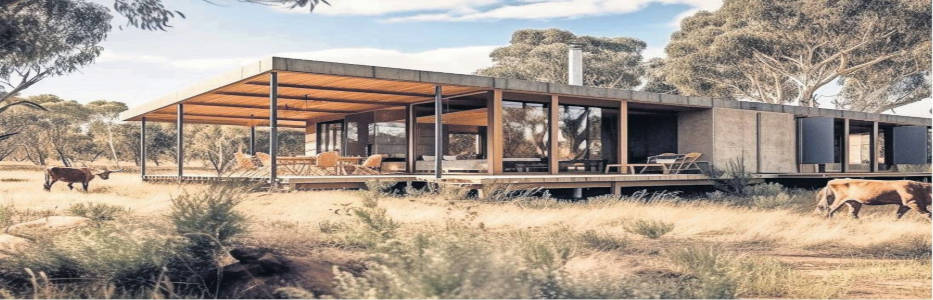
LOS ANGELES: Architects have now tapped AI to help design houses for country living for baby boomers.
When Melbourne architect Nick Travers started experimenting with artificial intelligence late last year, he ended up deep in a vortex of dystopian, Blade Runner-eque streetscapes.
It wasn’t ChatGPT that had piqued his interest, but rather an AI image-generating program called Midjourney.
Midjourney is an AI chatbot that converts text prompts into images, and was developed by a San Francisco-based independent research lab of the same name. The chatbot is available only through online community platform Discord.
“Initially, we just downloaded the free version and typed in some prompts. I would type in words like ‘large city, cyber punk, dystopia, stormy night’, maybe something about the lighting,” Travers says.
“And then we got these quite incredible images coming back. They are unique images that have never existed before.”
(Midjourney, and other AI art tools such as Stable Diffusion, was earlier this year the target of a lawsuit by a group of artists claiming copyright infringement. During a hearing in San Francisco last month, the judge said he was inclined to dismiss most of the lawsuit, but has allowed the artists to resubmit their complaint with more evidence.)
Travers and his team at Techne Architecture + Interior Design started dabbling with the program for fun, but they have started to use Midjourney to help with actual design projects.
At the start of each new project, the team uses keywords to get creative with ideas. Previously they would have gone to Pinterest or used Google to find images that best represented these “big thought bubbles”. But they would be singular images representing different aspects of the one project.
Now, Techne uses Midjourney to come up with one original image that combines all those different aspects.
“We aren’t looking for Midjourney to design the project for us,” Travers says. “But we are always trying to put narrative and concept into our work, and that’s where Midjourney helps a bit.”
They then pair the image with a vision statement, to “bring the words to life”, and add it to a design document.
“In many ways, the Midjourney output hasn’t yet had a major or direct influence on our creative output. But it has been illuminating to appreciate the potential,” Travers says.
One example is the conceptualisation of a new Techne project, a residence on a cattle farm in rural Victoria near Albury.
The team typed in: “Rural homestead interior modern Australian architectural design within a scenic cattle station with bright summer light” and Midjourney produced images like the one above.
Techne also uses a new artificial intelligence add-on to image-making program Photoshop, which allows users to manipulate images. For example, once an architect has created a render of a building they can then add objects such as trees, cars and people to make it look more realistic.
Previously, they would have had to tap into a library of images then copy and paste them in.
“Now, with this Photoshop AI, you can highlight an area on the image and say, basically, ‘put plants here’ and describe the plant, or ‘put a car here’,” Travers says.
He says it saves the team time on the “boring parts” of the process.
“It’s not that you spend less time overall, but that you can spend more time on the quality aspect on the production,” he says.