Major retailer to begin selling D.I.Y. tiny homes
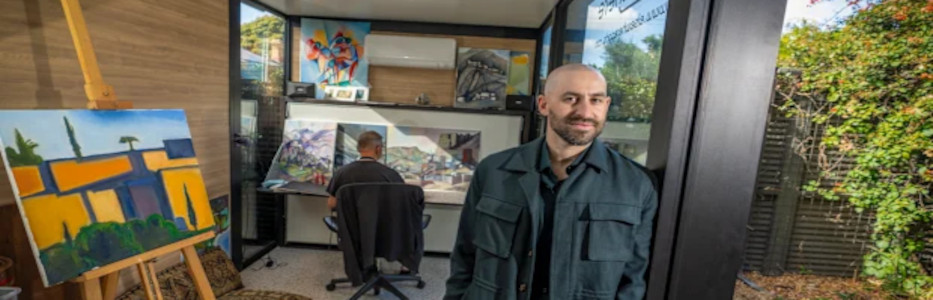
LOS ANGELES: Tiny home sales have received a major boost with a major retailer supporting a sales initiative.
Australians can build a tiny home, office or extra bedroom in their backyard over a weekend for $45,000 with Bunnings partnering with a modular home start-up to sell flat-pack studios, capitalising on a need for innovative housing amid an affordability crisis.
Elsewhere Pods, a luxury tiny home builder, sells prefabricated pods in a range of sizes from full double-storey tiny homes to 2.7-metre-wide rooms – but their new range allows customers to assemble their own structure without needing a building permit.
The new DIY pods that the start-up is supplying to Bunnings put the hardware retailer in competition with smaller tiny home builders as well as online giant Amazon, which offers “foldable” tiny houses from $11,300 that can be delivered to a Sydney address within a month.
Regular-sized prefabricated or modular homes are increasingly being seen as part of the solution to Australia’s housing supply crunch, as they can be assembled in a factory in 12 weeks, compared to a traditional house build that takes more than a year on average in NSW.
At the same time, more people are turning to granny flats, tiny homes and studios as a cheaper way to live or to expand their homes, a trend driven as much by a lack of housing affordability as a lifestyle choice.
Elsewhere Pods founder Matt Decarne says a tradesperson, handyman or anyone experienced working with tools would be able to construct the pods but he admits it’s a step above assembling IKEA furniture.
“Once we were able to explain [to Bunnings] how special this flat-pack system is and how simple it is to build, and started talking about DIY, this is when they became quite excited,” Decarne said, after the product made a soft launch in the stores in December.
“What we’ve launched with Bunnings is a subset of our broader designs that are standardised for simplicity and also that are limited to designs which don’t trigger building permits.”
The DIY pods from Bunnings cost $42,900 for a 4-metre by 2.4-metre black studio or $26,100 for a smaller 2.7-metre by 2.4-metre one.
“We’ve offered Quickbuilt‑branded outdoor rooms before, but this is the first time we’ve offered outdoor rooms with such a modern, architectural look. They’re sleek, stylish and bring something fresh to the range,” Bunnings chief operating officer Ryan Baker said.
“Tiny homes and outdoor rooms offer great flexibility. They can be anything from a home office to an extra bedroom, studio, pool house or hobby space – all without the cost and complexity of a full renovation. As customers look for affordable ways to add value to their homes, demand for this kind of product continues to grow,” Baker said.
Meanwhile, IKEA home expert Christine Gough says the global champion in ready-to-assemble furniture is maintaining its focus on products for small-space living and has no plans to start selling tiny homes.
Decarne, formerly an international trade law consultant, turned his side project into a full-time business when his mother lost her home in the 2020 northern NSW floods.
“She lost everything: her car, all her possessions, all my childhood memories, all gone. I had a vision for something that could be a structure that is built so quickly that it serves emergency and affordable housing, but also when the emergency is over, you actually want to keep that structure,” Decarne said.
Decarne’s mother was forced to stay at friends’ houses and couch-surf in the aftermath of the floods, but within eight weeks, he had built her a tiny home pod as communities rebuilt after the natural disaster.
Before the Bunnings deal, 40 per cent of Decarne’s pod sales were for Airbnb investors looking to generate an income from their regional properties, as the large glass panels suit tree-lined or isolated areas where tourists pay to stay and disconnect within nature.
But most of his other customers are buying the pre-assembled pods, which range from 3 metres long to 12 metres and start at $58,000, for backyard tiny homes, offices, yoga studios, gaming rooms or extra bedrooms, with some designs having a build time of four days.
Australian Tiny House Association president Danielle Lester says the organisation is seeing huge growth in the popularity of tiny houses out of necessity rather than as a lifestyle trend.
“For single-income households, older women, regional workers, first home buyers and many others, tiny homes represent one of the few remaining ways to secure adequate housing without taking on unsustainable debt,” Lester said.
“Their appeal isn’t driven by minimalism or novelty, but by the reality of a housing system that is no longer meeting many people’s needs, forcing innovation to fill a gap left by policy and supply failures,” Lester said.
Tiny homes are loosely defined as either having wheels or being transportable but they do not have a legal definition, so councils in Australia have their own rules, with most requiring permits or development application approval.
Granny flats are fixed to the ground, detached dwellings located on the same property as a house. Most states in Australia allow granny flats to bypass council approval if they are 60 square metres or fewer and meet a checklist of elements, such as having the right block size. Caravans are mostly defined as recreational vehicles.