Affordable housing entities team up on sustainable social housing
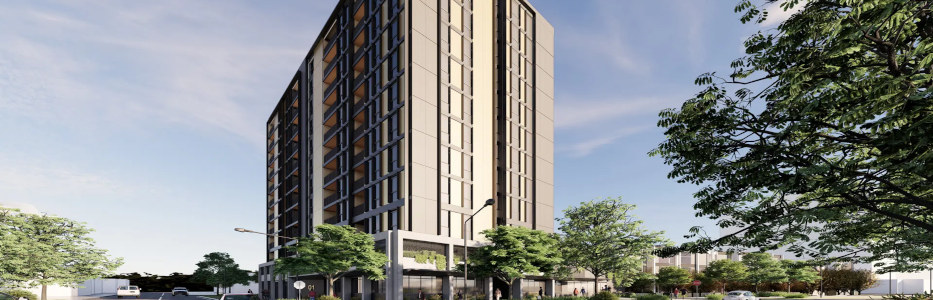
LOS ANGELES: A pair of affordable housing entities are set to team up to develop a series of multigenerational communities.
From securing critical funding through Homes Victoria, to embedding sustainability at the heart of the Dandelion and Cumulus projects, they discuss the role of resilient design, the importance of meeting community needs, and the long-term social and environmental benefits these developments will bring to Greater Dandenong.
Architecture & Design: What role did HIP V. HYPE play in guiding Launch Housing’s successful funding application to Homes Victoria, and how crucial was sustainability in shaping that bid?
David Mahony: Homes Victoria’s funding programs prioritie projects that are sustainable, resilient and valuable long-term investments, so responding to this in a robust and meaningful way is an essential part of the funding application process.
Samantha Ace: In 2022 Launch Housing engaged HIP V. HYPE to support our funding application for the Dandelion project, which was our first time working together. We then brought them onboard for the Cumulus project in 2024. Both projects were required to meet a minimum 4-Star Green Star certification from the Green Building Council of Australia.
David Mahony: HIP V. HYPE (HV.H) supported Launch Housing’s successful 2022 funding application to Homes Victoria, ensuring alignment with Homes Victoria’s sustainability targets, Launch Housing guidelines, and all other relevant policy and legislation.
This meant that ESD and Green Star Buildings were embedded in the application and earliest design options, Including the key principles of passive design. Sustainable strategy guided many aspects of the application, and flowed down to influence architectural, landscape, structural, and services design for the projects.
The projects in Dandenong will deliver a mix of studios and one- and two-bedroom apartments; how did you determine the right balance of housing types to meet community needs?
Samantha Ace: During the project visioning process Launch Housing consults the Victorian Housing Register to assess the demand for social housing in that particular location. At the time of the tender, the majority of demand for housing in the Dandenong District Broadband area (in the priority access category) was for one- and two-bedroom homes.
For the Cumulus project, which includes 10 studios, 48 one-bedroom and 31 two-bedroom apartments, the homes have been designed to meet a higher level of accessibility (77 meet Gold Level and 12 meet Platinum Level under the Liveable Housing Australia guidelines). This will facilitate ageing in place for residents over the age of 55 and pre-emptively meet their evolving requirements for space.
For the Dandelion project, which includes 40 one-bedroom and 30 two-bedroom apartments, there will be a broader mix of residents including single people, couples and families.
You are supporting the delivery of 4-Star Green Star certification; can you explain what this means in practice for future residents in terms of comfort, energy efficiency and long-term resilience?
David Mahony: A 4-Star Green Star Buildings rating signifies ‘Best Practice’ in Australia, meaning the development will be a higher performer in many categories including energy, internal environmental quality, water conservation, and climate resilience.
Green Star Buildings is a holistic and targeted tool, and HIP V. HYPE was involved with the project team from early in concept design to ensure all targets were incorporated early in the process.
In terms of comfort, residents will experience an exceptional living environment within their new homes. The buildings boast excellent indoor environmental quality, including superior air quality, abundant natural light, and effective ventilation.
This leads to significantly more comfortable internal conditions, more stable temperatures, quality natural light – impacting on the health and wellbeing of residents – even during Dandenong’s increasingly extreme weather events.
The building utilises high-performance building envelope materials and glazing, energy-efficient systems and lighting, and integrates on-site renewable energy through rooftop solar PV system to minimise operational energy consumption. A minimum 7.5-Star average NatHERS rating means lower utility bills due to reduced energy requirements for heating and cooling, with both of these projects targeting a higher NatHERS average.
A Community Resilience Plan has been developed for the developments to identify resilience objectives and goals with serving the local community. This includes consideration of climate impacts and increasing extreme weather events, and how they will impact more vulnerable residents. The robust design of the buildings ensures less wear and tear resulting in lower ongoing maintenance costs. This also results in fewer interruption to residents from ongoing maintenance.
Samantha Ace: The whole-of-life sustainability approach adopted by both projects will make a real change to the lives of the people living there. For example, by reducing utility bills for residents, who are typically on very low incomes, leading to a tangible difference to the household budget.
As part of the Community Resilience Plan, Launch Housing hosted a workshop, which was attended by local community groups and support agencies. The group reviewed the draft Community Resilience Plan and identified several priority actions to mitigate the social, financial and human shocks and stresses that our residents could face.
These included providing financial literacy support, prioritising mental health services, introducing initiatives to prevent social isolation, and activating communal spaces for social groups to facilitate community connection.
By Identifying potential challenges early, we can leverage our network of partners within the Dandenong community to create a proactive framework to Implement strategies to set our residents up for success at the beginning of their tenancies and empower them to maintain those connections once they are established.
With more than 5,100 applicants in the Dandenong District Band awaiting social housing, what impact do you hope these homes will have on the local community, both socially and environmentally?
Samantha Ace: There is no question that Greater Dandenong needs more social and affordable housing. On the night of the last Census, there were over two thousand people experiencing homelessness in Greater Dandenong.
That’s equivalent to one in 67 residents. Yet despite having the highest level of homelessness in the state, Dandenong ranks 23rd among Victorian councils for available social and affordable housing. A lack of social and affordable housing has been identified by the Greater Dandenong Council as a key reason for these high levels of homelessness.
The Cumulus and Dandelion projects will support the provision of secure, affordable social housing for 159 households, creating a stable base for these families within the Dandenong community.
Our community engagement has highlighted Dandenong as an incredibly diverse, multicultural community with a strong sense of connection. Many local organisations and grassroots groups play an important role in supporting and strengthening this community.
Launch Housing has been part of this community for over 30 years, through our crisis accommodation site and more recently through our involvement with Advance to Zero (in partnership with Council). The delivery of the Cumulus and Dandelion projects will extend our Involvement across the housing continuum from homelessness support through to community housing.
This history and well-established connection within the Dandenong community will enable us to support our residents to foster their own sense of connection within their new community.
David Mahony: Ensuring the developments not only met sustainability benchmarks but also genuinely served Dandenong’s diverse community required close engagement to understand the broader Dandenong demographic and socio-economic context of the site.
This was done in the creation of a Community Resilience Plan, which included defining the local community and identifying the resilience objectives and goals associated with serving the community.
Additionally, both projects committed to responsible social procurement; at least 2% of the total contract value has been directed to generate employment opportunities for disadvantaged and under-represented groups.
The developments create a new model for future social and community housing in Dandenong – sustainable, high-quality medium-rise residential buildings that are safe, accessible, and well-connected to public transport and amenities.
Looking ahead, how do you see HIP V. HYPE’s partnerships with organisations such as Launch Housing, Hayball, Genton and DCWC shaping the future of sustainable and affordable housing in Victoria?
David Mahony: HIP V. HYPE’s partnerships with organisations like Launch Housing, Hayball, Genton, and DCWC are setting a new standard for community housing in Dandenong, and throughout Australia, by demonstrating that high-quality sustainable design is not a luxury but an essential component of socially responsible development.
As the delivery of housing is scaled up in Australia, it is crucial for all project collaborators to embed sustainability into the design so that the residential buildings being delivered are robust, durable and liveable. By bringing together teams that prioritise the above, we can ensure that the projects we are delivering benefit both residents and the environment.
Samantha Ace: Launch Housing looks forward to maintaining our values-aligned partnership with HIP V. HYPE to ensure that we continue to design and deliver resilient buildings that meet the evolving needs of our residents and respond to the current and future constraints and opportunities of the neighbourhoods in which these homes are being delivered.