Drones now fly blood samples in skies for first time
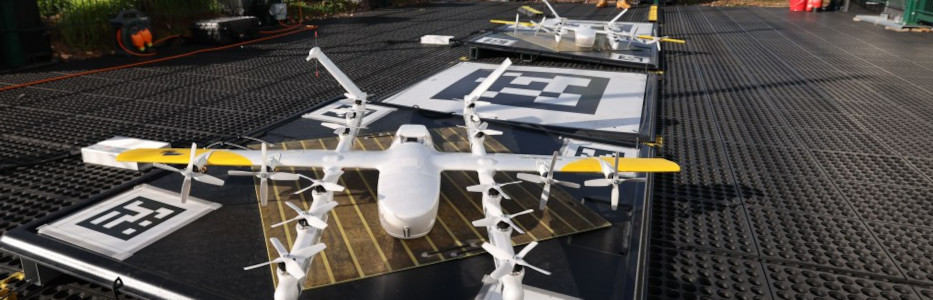
LOS ANGELES: A hospital has deployed drones for the first time to deliver blood samples between hospitals in two minutes rather than a 30-minute journey through the capital’s congested streets.
Following their launch on Tuesday, drone flights will hop between the rooftops of Guy’s and St Thomas’ hospitals containing samples from patients at risk of bleeding disorders who are set to undergo surgery. These will be analysed and help to speed up decision-making on whether to go ahead with an operation.
At present samples are delivered by van or motorbike from Guy’s Hospital, next to London Bridge station, where surgery takes place, to St Thomas’ just opposite the Palace of Westminster, where complex lab equipment is based.
Now, they can be booked onto a flight, hooked onto one of the four drones waiting on charging pads in a specially created pen on the roof of Guy’s Hospital and dispatched across London.
The six-month project is a venture between Apian, a British technology start-up founded by junior doctors in partnership with Wing, a drone business backed by Alphabet, the owner of Google, and Guy’s and St Thomas’ NHS Foundation Trust.
After almost two years in the planning to accommodate the clinical drones, the Civil Aviation Authority and Nats, the air traffic management service, have opened up a flight path for the service in London’s busy and highly secure airspace.
Apian describes itself as a “healthcare logistics” business that wants to become the “Deliveroo of medical transport”, creating a platform to match up clinicians with urgent transport requests and commercial drone companies.
It was founded in 2020 by Dr Christopher Law and Dr Hammad Jeilani along with Alexander Trewby, formerly of Google Health. Apian spun out of the NHS Clinical Entrepreneur Programme, where Trewby, 49, was a mentor.
Dr Jeilani, 26, said he was aware of drones from a young age, but for the wrong reasons: “I’m originally from Afghanistan and my parents fled the country to come to the UK.
“As I was growing up, the war in Afghanistan was still very much going on and drones were in my mind, being used to deliver death and destruction. And I pondered why we couldn’t use this technology to deliver healthcare and save people’s lives.”
The idea struck him at medical school. “It became very apparent that one of the biggest problems in healthcare around the world, regardless of the nation you’re in, is healthcare logistics. It’s estimated that half of all vaccines manufactured are wasted because of poor logistics,” he said, citing World Health Organisation statistics.
The business now employs 23 people and has raised money from the venture fund Local Globe and King’s Health Partners, the venture arm of the NHS, along with grants from the European Space Agency.
Apian has partnered with Wing before on medical drone deliveries in Dublin and has worked on pilots in rural areas of the UK. In 2022, it flew the first prescription medicine in partnership with Boots from Portsmouth to the Isle of Wight.
“It’s about how fast drones are,” Trewby said. “And then it’s about how reliable they are, that they’re not stuck in traffic or that they do arrive when they say they’re going to arrive”. There is a catch to this. Drones cannot fly in all weathers and they are affected by rainfall.
However, lightweight commercial drones can reduce carbon emissions by up to 99 per cent compared with the use of standard, non-electric cars, according to a study by Accenture, commissioned by Wing.
Guy’s and St Thomas’ is one of the biggest hospital trusts in the UK and one of the largest teaching hospitals, employing 23,600 staff and with an annual turnover of £2.9 billion.
Lawrence Tallon, the trust’s deputy chief executive, said: “When we’re using London’s busy and congested airspace, we have to do a lot of detailed logistical work with the Civil Aviation Authority to make sure that as we’re flying samples around, that’s being done safely and there’s no risk to those samples as they fly.”
He added: “The commercial details are confidential but we will scale this up in a way that is more efficient and a better use of taxpayer money than the alternative — paying human drivers to drive expensive vans around London.”