Planners share designs for Intergenerational Community Campus proposal

LOS ANGELES: Plans for a senior housing complex, senior centre and a community resource centre at a proposed Community Campus are moving ahead.
The Ramona Intergenerational Community Campus (RICC), conceptualized more than 25 years ago, is set to include the Paseo Norte Apartments, a 100-unit affordable senior complex; a senior center; PACE medical clinic and a Ramona Community Resource Center.
The project is planned for two parcels on about 8 acres north of Main Street between 12th and 13th streets.
County staff, architects and others gave updates about the project and presented preliminary designs at the Ramona Community Planning Group’s Oct. 6 meeting
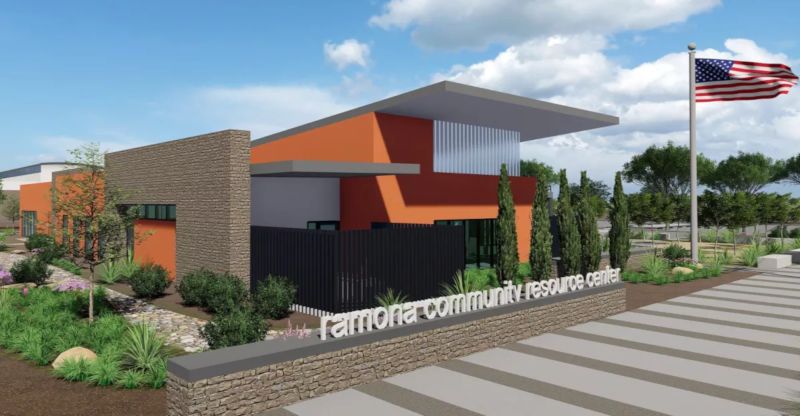
The 7,500-square-foot Ramona Community Resource Center at the corner of 12th and Main streets is being designed to replace the 3,200-square-foot Health and Human Services agency space adjacent to the Ramona Sheriff’s Department substation at Montecito and Main streets.
The building would accommodate child welfare, public health and behavioral health services. Visitors would access Medi-Cal, CalFresh, formerly known as Food Stamps, and other temporary assistance such as welfare programs.
The estimated $15 million resource center is set for a groundbreaking in April 2023 and completion in summer 2024, said Stephen Schmidt, deputy director of capital construction, Department of General Services, for San Diego County.
The center plans include an ambassador station, lobby, two interview rooms and a training room with adjacent outdoor space, said architect Julio Medina of Sillman architectural firm in San Diego. Also housed in the building will be a nurse’s office with two stations, office space and breakroom, a mother’s room and wellness room, and a fitness center.
Ramona Community Planning Group members offered suggestions for modifying the plans.
Planning Group member Dawn Perfect, who has been involved with the RICC project since 1999, said a community gathering space should be incorporated with a promenade entrance along Main Street. She suggested improving the campus flow and making the entrance more inviting to visitors.
“I’m a huge supporter of the project, but not with what I see tonight,” Perfect told the presenters. “Just a little more tweaking of the plan would be nice.”
Member Torry Brean said walkability of the site could be improved with commercial enterprises such as a coffee shop or hot dog cart.
Debbie Foster, a Planning Group member, objected to plans for a security guard at the entrance, which she said is not very welcoming and sends a message that disruptions are anticipated.
Several members asked for more community involvement in the planning process, either through workshops or design presentations.
Schmidt said county staff are planning a presentation at a Ramona Design Review Board meeting in the near future. Architects would consider public comments and possibly incorporate requests such as adding a promenade if possible.
Plans for the estimated $38 million Paseo Norte Apartments and $6 million senior center were more well-received by the Planning Group members.
The apartments call for 85 one-bedroom and 15 two-bedroom units in a two-story building. A lobby and community room are included in the apartment building, said John Sugden, project manager for the San Diego-based developer, Wakeland Housing and Development Corp.
The senior center will be about 5,000 square feet and a PACE medical clinic primarily for seniors will be 10,000 square feet, with both uses in the same building, Sugden said. PACE stands for Program of All-Inclusive Care for the Elderly.
Outside, the project incorporates a roughly 2-acre park with a trail near the Santa Maria Creek. A central courtyard will have barbecue grills and bocce ball area.
“The park with the trail will be given to the county Parks and Recreation Department,” Sugden said. “We’ll build it, but we will not maintain it — county Parks will.”
Groundbreaking for the project is set for April 2024 at the earliest, he said.
Planning Group Chairwoman Robin Joy Maxson asked if Ramona residents could be given priority in renting the affordable apartments.
In response, Lisa Huff, development director for Wakeland Housing and Development, said the project can be marketed in Ramona and there would be an opportunity for community members to apply and be added to a wait list.
In addition to updates on the apartments, community resource center, senior center and PACE clinic, county Project Manager Jim Bolz said the 13th Street Bridge project adjacent to the RICC has also cleared environmental hurdles and is ready to move into the final design phase.
The bridge structure begins about 600 feet south of Walnut Street and ends at the intersection of 13th and Walnut streets. The estimated construction cost of $14 million is fully funded by a Federal Highway Administration Grant through a Highway Bridge Program administered by Caltrans.
The bridge’s original design included 10-foot-wide equestrian/mixed-use trail that would have been separated by a barrier next to two 16-foot traffic lanes, one in each direction, two 10-foot shoulders and a 6-1/2-foot sidewalk for pedestrians, Bolz said.
This concept exceeded the design features that would be allowed by the Highway Bridge Program, Bolz said. The bridge is now planned with two 12-foot lanes, one in each direction for motor vehicles with 3-foot-wide shoulders, and a barrier separating the traffic lanes beside an 8-foot mixed-use pathway for pedestrians and equestrians.
Bolz said construction of the bridge could start in 2024 if everything goes as planned in the right-of-way appraisal and acquisition phase.
Brean suggested the bridge project include decorative elements; Bolz said he would look into it.
-
- This concept design shows what a future Ramona Community Resource Center could look like at 12th and Main streets. (Sillman)