Unique multigen co-housing community created by cluster of families

NEW YORK: A new co-housing development aims to serve as a model, where impromptu gatherings are by design.
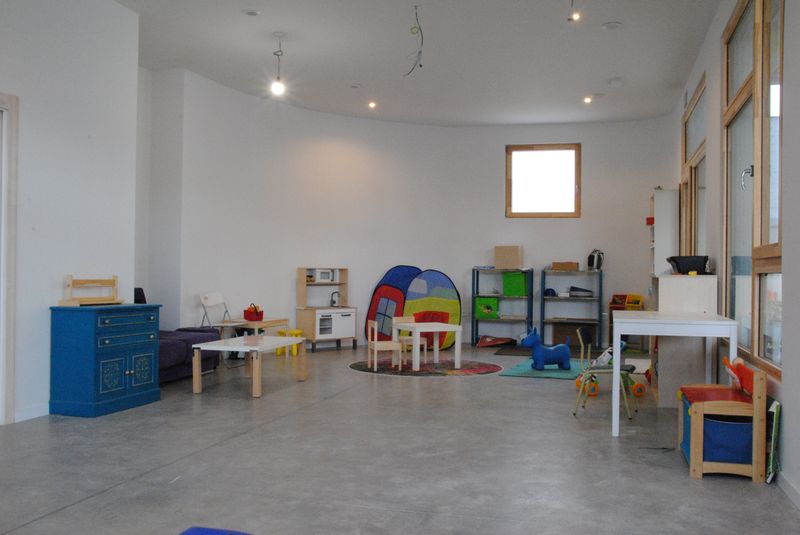
When Madrid’s schools were closed in January due to the coldest weather in fifty years, parents living in the Entrepatios cooperative housing development already had a model that would have made many parents struggling through pandemic closures jealous. Their onsite “school” was inaugurated. Thanks to child care shifts and a Google calendar, working parents were able to focus on their day jobs most of the time, while their children took part in a kids’ yoga class, a sleigh ride in the snow or a performance in the communal playroom.
“It’s like a village,” says Cintia Díaz-Silveira, who moved into the new cooperative housing apartment block at the end of 2020 with her partner and two children, ages three and one. For Díaz-Silveira and her fellow inaugural residents, their new living situation is their answer to the refrain “it takes a village to raise a child.” And they hope it can be a model for others who want to start something similar but don’t know how.
“We have our own bar, our own hairdressers, our own consumer group. We don’t need to go shopping because everything gets delivered,” she joked of the apartment building she shares with 16 other families and 23 children. The complex is the first of its kind in Madrid, and part of a cooperative housing movement that’s starting to expand in Spain and elsewhere.
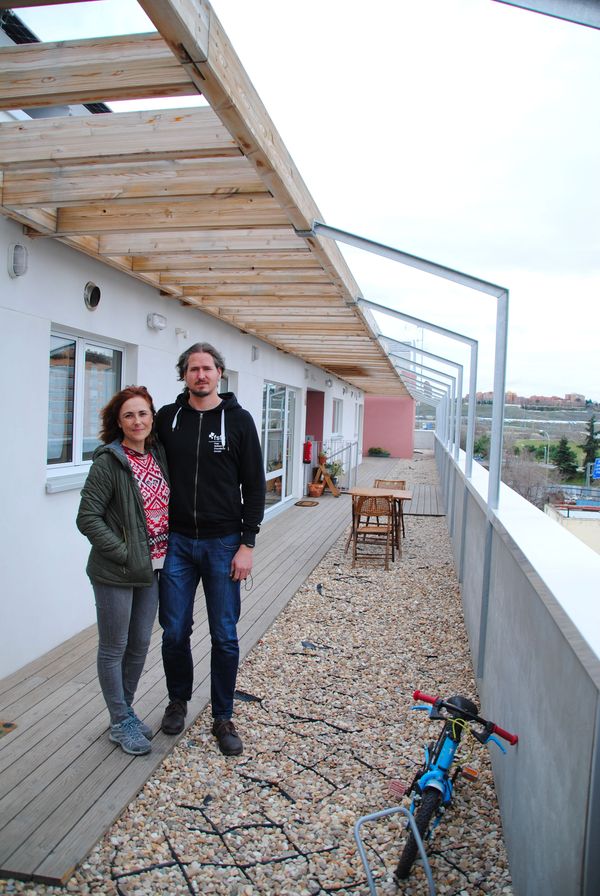
By “the bar,” Díaz-Silveira is referring to Friday afternoons, when fellow residents have band practice, and many more residents go up to the terrace to enjoy a beer and live music. Like much at Entrepatios, the evenings are impromptu; recently the grown-ups enjoyed an open-air screening of Dirty Dancing. The “hairdresser” is a neighbor who’s good at cutting the children’s hair. “Someone gives great massages and someone else does yoga. We share our know-how with the group, and all our needs when it comes to parenting too,” she said. There’s not much need to hire babysitters, either, with some parents banding together to cover child care.
“We take turns,” said Diaz-Silveira. “On Fridays, there’s cinema. One family takes six children, so the rest of the parents have that evening for themselves.” On Mondays many of the children have a shared English class. Other evenings, a family might arrange an impromptu games night and send a message to the rest of the residents via Telegram.
Cohousing projects like Entrepatios have been gaining ground in Spain, particularly in Catalonia, where the number of cohousing homes has doubled between 2019 and 2021 thanks to a Barcelona City Council initiative that provides free public land to cooperatives with two goals: accessibility and sustainability. In Madrid, three other projects are now in development that follow the model of Entrepatios.
Eva Morales, a professor at the University of Malaga who advises people on starting cohousing arrangements, said the phenomenon is expanding at a rate she didn’t expect to see in her lifetime. She points out that Spain doesn’t have a cohousing culture like its neighbor France does, and that people like her who have been interested in the concept doubted it would ever take off. “While there still aren’t many examples of cohousing to see because of the long process involved, my feeling is that it’s emerging at a significant speed — something I wouldn’t have said five years ago,” she says.
Models of communal living vary, from the Israeli collectivist model of the Kibbutz that historically also incorporated economic work, to cooperatives and group houses. The model known as “cohousing” originates in Denmark, and envisions common spaces surrounded by private homes with some shared decision-making, and sometimes alternative ownership models. Architect Jan Gudmand-Hoyer attempted the first such Danish community, and the idea was propelled forward in the late 1960s after a newspaper article by Bodil Graae declared, “Children should have 100 parents.” A popular German version of the concept known as Baugruppen emphasizes residents’ role in custom designing their developments. While some modern cohousing projects are more oriented toward families, others focus on seniors or even young adults.
In places like Berlin, New York, Denmark and Uruguay, where the cooperative housing movement is much older than cohousing, the newer movement “has provided freshness and ideas when it comes to co-designing participatory processes and including the environmental perspective in building management,” says Eduardo González de Molina, a researcher at the Barcelona Municipal Institute of Housing and Rehabilitation.
Díaz-Silveira, a psychologist and university professor, says she was looking to live in a community for a long time, but many were in the countryside and she needed to be in the city for work. She found out about Entrepatios when a friend posted on Facebook in 2015. Land purchase was imminent; Díaz-Silveira herself was embarking on a new relationship with her partner, who loved the idea even more than she did.
“It’s easier to live as a family,” says Díaz-Silveira, reflecting on the time before and after Entrepatios. She remembers the long distances needed to socialize with friends. Now those needs are met by the “encounters” that take place daily in an “easy, natural way,” thanks to the design of the space they live in. Clothes are handed down from older to younger children. Parents pick up parenting skills from those around them. Last-minute print-outs for school are made possible with a neighbor’s printer. Even pets are enjoyed by numerous families. Not all of the participants have kids, though most do.
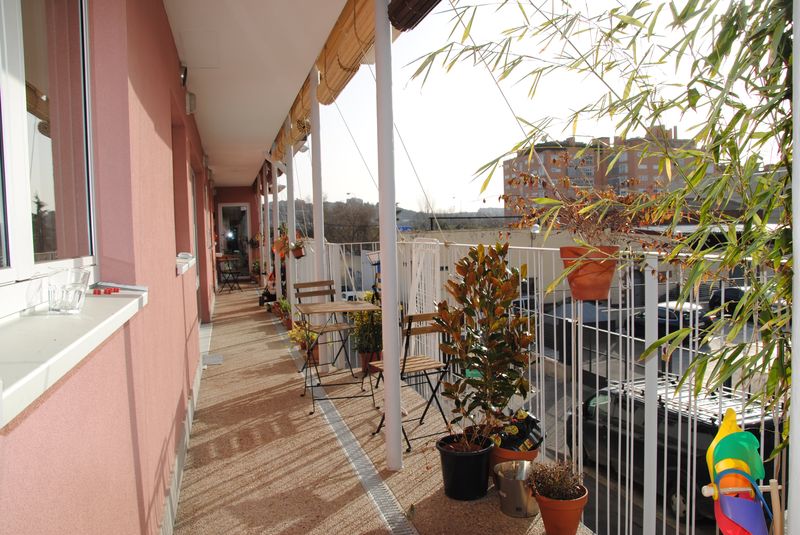
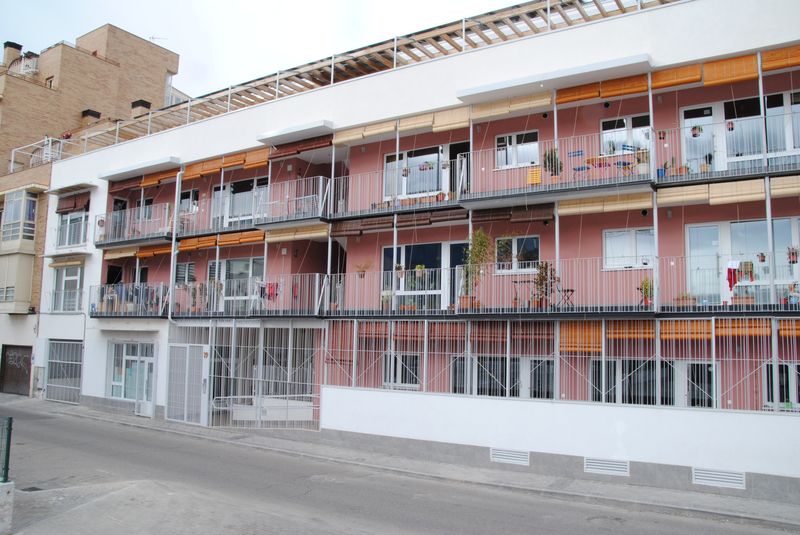
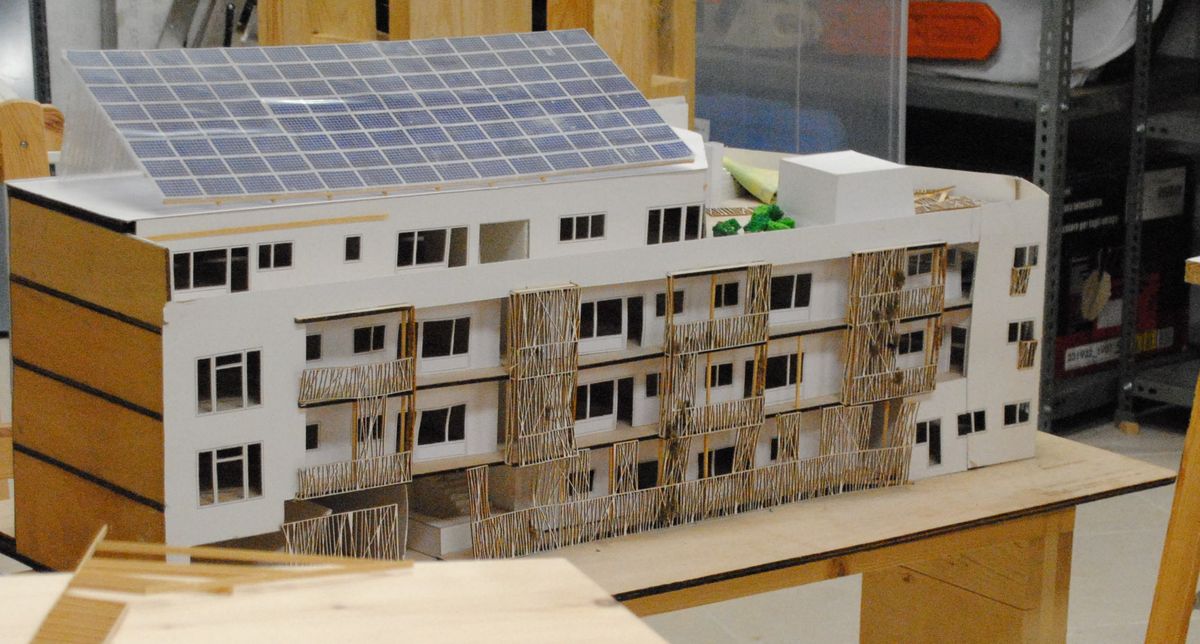
Residents at Entrepatios each have their own small apartment, and unlike in some shared housing, their own kitchen. But a central feature of the space’s design is one long patio that connects the apartments, la corrala, a once-common design element of old-fashioned Spanish architecture that facilitates indoor-outdoor living.
Morales says la corrala, which had fallen out of favor in many newer designs, was once “where there was lots of common life, where the children grow up together and spend the afternoon. [It’s] where everyone raises the neighbors’ children.”
That ethos is built into the name of the community, Entrepatios, which translates to “between patios.” The line between people’s apartments and communal space is further dissolved by literal open doors and uncovered windows.
On the day I visited, some front doors had been left open, many still with the keys dangling in the lock. Full-length windows were purposefully left bare. No curtains are needed here. Some residents went for a clear glass door; others, for opaque. “That’s their choice,” says Pablo Fonte, one of the original founders of the coop and a caregiver at El Arenero, a shared parenting space that my child attends with some of the children at Entrepatios. Díaz-Silveira opted for uncovered windows and a transparent glass front door. They like to see out, and let the natural light in.
Those uncovered windows are also a key prong of the development’s sustainability, a second of the cooperative’s core values after communal living. North and south-facing façades ensure maximum natural daylight, and the absence of shutters encourages efficient warming; la corrala keeps them cool during summer months by providing shade. The building is constructed of wood, and fitted with other eco-friendly features, including solar panels, and a a 10,000-liter tank in the basement that sits ready to reuse shower, sink and rain water in the toilet system as soon as it becomes legal. “The balance was between being as ecological as possible, and making it financially accessible,” says Fonte.
One of the ways Entrepatios stays affordable is through its ownership model, another one of its pillars. It uses a “grant of use” formula that means residents don’t own — and can’t sell — their apartments. But they do have the right to use them for life, and should they decide to leave, they receive the down payment they made for the purchase of the land. In the meantime, the mortgage — which is paid to the coop — is half the going rate of that in the neighborhood, according to a recent market study by architect Iñaki Alonso, one of the development’s founding members.
De Molina, who works with Barcelona’s housing agency, says cohousing “is gradually becoming a niche option for access to dignified and adequate housing, an alternative to the traditional buy-sell dichotomy.”
Building from scratch
Cohousing arrangements that have been around for decades offer lessons in some of their long-term downsides: They can come with a deluge of time-intensive meetings. They require a fair amount of relationship management, patience and diplomacy, as all decisions are made through group consensus. A lack of privacy is also a concern for some, and many American cohousing arrangements have featured a notable lack of diversity.
But for those who might desire this kind of lifestyle, one of the greatest challenges can be just finding your way into one. In addition to people, you’ll likely need a liability corporation or cooperative, land, financing, and then architects, buildings and a license. Not to mention, patience, perseverance and time.
In the case of Entrepatios, it took some very long-term planning, and for those interested in taking a family along, it’s a timeline perhaps not always aligned with the duration of childhood.
A small group of friends first started talking about the idea of living a different way 18 years before the project’s completion, around 2002. The group didn’t take its first formal step until 2011, when it formed a cooperative, and they spent 2012 to 2016 looking for land to build on. They purchased land in 2016, and Entrepatios opened its doors to families at the end of 2020.
Diaz-Silveira joined the project later and happened to find it at the right time in her life, when a family was in near sight. Other residents were desperate to make the idea a reality to house their growing families; if they hadn’t bought land in 2016, some would have had to bow out.
Marta González Reyes, a teacher and fellow founding member of the group, said part of the reason this effort took so long is the group’s attention to detail in the decision-making, from the positioning of the tiles to the types of windows. She hopes that others can borrow from this group’s decisions to cut down the time it takes to start future cohousing arrangements. The founding members are taking proactive steps to share their know-how with others. They work with and advise other coops in earlier stages of the process, show people around their complex and take part in events and workshops.
“Others could do it faster,” says Gonzalez Reyes. “We’ve made this as a model to replicate. We want this to be an example that shows that you can do this, that this is possible. This is real.”