25-foot lots developed for social housing in Downtown catchment
LOS ANGELES: It is a building that is easy to miss.
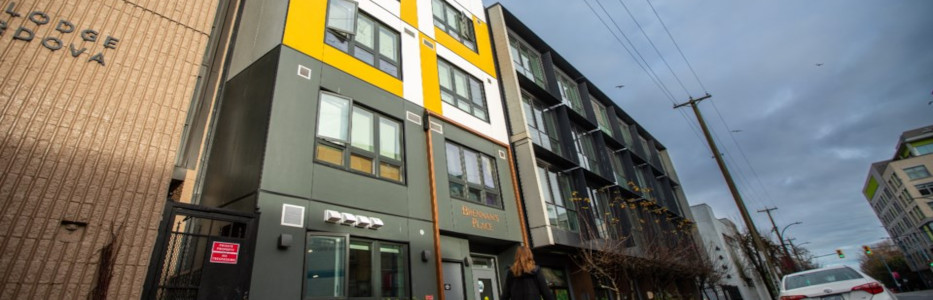
At just 25-feet wide, the slim six-storey Brennan’s Place at 545 East Cordova St. sits on a piece of property that used to serve as a small surface parking lot between two other residences on the block.
The concrete building, which resembles stacked modular housing, opened in December 2024 and serves as social housing for seniors, many of whom live with a mental illness, substance addiction, or both.
Brennan’s Place, which was named after Evanna Brennan, an outreach nurse who worked with her nursing partner Susan Giles in the Downtown Eastside for more than two decades, is owned and operated by Lookout Housing and Health Society.
The self-contained 20 studio apartments come with specialized services to cater to the needs of the tenants, who have either been homeless or at risk of homelessness at some point in their lives.
“Many of the folks that are in here may actually be in hospital without this [building],” said Shayne Williams, chief executive officer of Lookout Housing and Health Society, in an interview at Brennan’s Place.
“It wouldn’t take too long in the streets before they were so sick and ended up in emergency, in our medical system.”
While access to health care and supports is crucial for the tenants, those services couldn’t be contemplated until Lookout got the green light to proceed with construction of the building on the narrow lot.
In pushing for development of the property, Lookout took the innovative step to do something not many other property owners are doing in the Downtown Eastside: build social housing on 25-foot-wide lots.
According to information provided to BIV from the city’s planning department, there are 144 25-foot lots in the Downtown Eastside Oppenheimer District and four in the Thornton Park planning area.
A total of 121 are privately owned and 27 others are owned by governments or non-profits. Some are sandwiched between buildings—like Brennan’s Place—while others are what the city’s planning staff describe as “orphan” lots.
The data presents an interesting prospect for the ongoing need to build social housing in the Downtown Eastside—and one recently discussed by city council in its approval in December to revise the Downtown Eastside plan.
Inspired by housing activist Wendy Pedersen’s push to consider the small lots for social housing development—and, in turn, replace dilapidated single-room-occupancy (SRO) buildings—ABC Vancouver Coun. Lisa Dominato successfully added an amendment to the plan to allow more flexibility to build on the small pieces of land.
In particular, that flexibility would allow a developer to build up to 12 storeys instead of the current six storeys on a 25-footer. Modular housing and mass timber construction has been suggested as the preferred and less expensive building type.
Williams said the new allowances combined with the fact that government and non-profits own 27 of the lots could trigger another solution to get people housed in the Downtown Eastside.
“That’s great,” Williams said. “If you can get 30 to 35 [units] per site, what an amazing opportunity that would be for this community.”
While one-off projects would be welcomed, Williams said a scenario where several lots are assembled under one package and coupled with pre-approved building designs would be most effective in increasing social housing in the Downtown Eastside.
Large supportive housing sites are still needed, he said, but buildings that house 30 to 35 tenants would be easier to administer and integrate specialized services for tenants requiring, for example, support for an acquired brain injury.
The timing of such an idea comes as the two main politicians responsible for housing in Vancouver—Gregor Robertson for the federal government and Christine Boyle for the province—are residents who served on city council.
Robertson was mayor of Vancouver from 2008 to 2018 and Boyle served two terms on council until she was elected in 2024 as the NDP MLA for Vancouver-Little Mountain.
“I think it’s great for British Columbia to have folks that truly understand [the need for more social housing] and have good backgrounds to inform next steps in mitigating some of the challenges we’re facing,” Williams said.
BIV contacted both housing ministries to understand what the appetite of the federal and provincial governments would be for leading development of 25-foot lots. Boyle’s ministry declined to comment but did not provide a reason.
Robertson’s ministry provided a lengthy response in an email about the government’s Build Canada Homes strategy, but did not specifically answer questions about the prospect of developing 25-foot lots.
“Working in partnership with non-profits, Indigenous organizations, private developers, and all orders of government, Build Canada Homes will offer flexible financial options, including loans and contributions, to support projects that deliver long-term affordability, sustainability, and community benefit,” the email said.
“Partnerships are a cornerstone of Build Canada Homes’ approach, and the Government of Canada is looking forward to working closely with partners across Metro Vancouver to accelerate housing supply in the region.”
The government said it is currently accepting proposals through its application portal and hosting a series of virtual webinars in January and February 2026 to help applicants understand its “investment policy framework.”
“To protect the interests of its partners and ensure a fair and equitable process, Build Canada Homes does not disclose details on current or future discussions with specific partners,” the email said.
BIV has made several requests since May 2025 to interview Robertson about his portfolio, but his ministry has not accommodated the requests. As mayor, Robertson pledged to end “street homelessness” by 2015, but failed, pointing to lack of commitment on the housing file from the federal and provincial governments.
Brennan’s Place was built with federal money under the Trudeau government’s “rapid housing initiative” program. The City of Vancouver applied for funds for various projects and provided Lookout more than $10 million towards the construction of Brennan’s Place.
Williams acknowledged that creating 20 social housing units for more than $10 million doesn’t achieve the economies of scale preferred by developers, but cited challenges in getting the building built and being “a little ahead of the curve” on the project.
“A lot of ‘first times’ on this building,” he said, citing the partnerships with the federal government and municipality on such a unique project. “I think all parties involved learned a lot.”
The original plan contemplated the replacement of a city-owned and Lookout-operated building on Alexander Street at the same time as the Brennan’s Place project. Both were to have steel modular housing loaded onto the site.
The city building project fell through because of concerns over heritage.
Then came the complications over using modular housing on the East Cordova site, which Williams said was made difficult because of issues related to sealing off a new building between two existing buildings.
“So when you start dropping Lego pieces in, it’s, ‘How do you seal that off with confidence, from an envelope perspective, from an insulation and from a safety perspective,’” he said in explaining why the building is concrete.
“Maybe since we pitched this three years ago, maybe the City of Vancouver has made some progress on how to do that. But at the time, they said, ‘No, we haven’t done that before.’”
In an email Monday, the city’s communications department said the site’s close proximity to neighbouring buildings raised safety and building code challenges that made modular construction difficult and costly.
“Because the project was funded through the Rapid Housing Initiative and subject to very tight timelines, there was limited opportunity to explore alternative modular options further.” the city said. “As a result, Lookout made the decision to move forward with concrete construction, a method that could meet all building and safety requirements of the site without further delay.”
Brennan’s Place is what Edna Cho, a senior planner in the city’s housing policy, planning, urban design and sustainability department, described as a demonstration project.
Cho echoed Williams’ comments about the economies of scale question around building 20 units for more than $10 million. At the same time, she said, allowing the small lots to be developed is a “good option to have” for property owners.
Dan Garrison, the city’s director of housing policy and regulation, planning, urban design and sustainability, said there likely wouldn’t be a big appetite for owners of private lots to take up the city on the new 12-storey change.
“The most likely scenario here is that if you own a 25-foot lot, you’d be looking to sell that lot to a non-profit or to a government, BC Housing, or the city or somebody to do a project on that site,” Garrison said. “That’s by far the most likely way that this would happen.”
At present, six-storey buildings are still the most cost effective to build, he said, unless there is innovation “on the mass timber modular side of things” that creates and easier or comparable pathway to reach 12 storeys.
“Of course, everyone’s hope is that we see that change—and it is a push of the federal government right now and the Build Canada Homes initiative to try to catalyze that change,” Garrison said.
The email from Robertson’s ministry said Build Canada Homes aims to generate “a more productive housing industry by creating predictable demand for modern methods of construction, including modular and factory-built housing and mass timber.”
Meanwhile, Coun. Dominato said she has taken “an enormous interest over the last number of years” in mass timber construction and how it can be used for housing projects in Vancouver.
That interest led her to tour Intelligent City, a Delta-based business that delivers turnkey, prefabricated mass timber urban housing that the company says is sustainable, affordable and livable.
“There’s others that are in this business, too,” she said. “I’m of the view that we need to be open to trying new things.”
Whether mass timber matches up with development of 25-foot lots is an open question, but Dominato said she appreciated what Pedersen, executive director of the SRO Collaborative, brought forward to council.
“I appreciate the community is generating this [idea]—this is coming from the community and people who work with the SROs,” she said.
“If there was a way to leverage those sites to build the social housing fairly quickly, but also leverage a swing space, I think that could be a positive. It also might tie in nicely with some of the federal housing funding.”
Pedersen said she was glad to see Dominato support the development of 25-foot lots. Her hope is that it leads to an accelerated replacement of aging SROs. Like Williams, she favours an assembly approach to developing the narrow lots.
“I can not see them every time I walk around the neighbourhood now,” said Pedersen, who did her own research in the summer on the number of 25-foot lots in the Downtown Eastside.
She said she wasn’t aware of Brennan’s Place until she came across it during her mapping exercise.
“I flipped out when I saw it because I thought, this is the answer and why aren’t we talking about this?” she said. “This is the perfect thing. This is the right size, and we could use these lots that you can’t really use for anything else. They’re just sitting there doing nothing.”